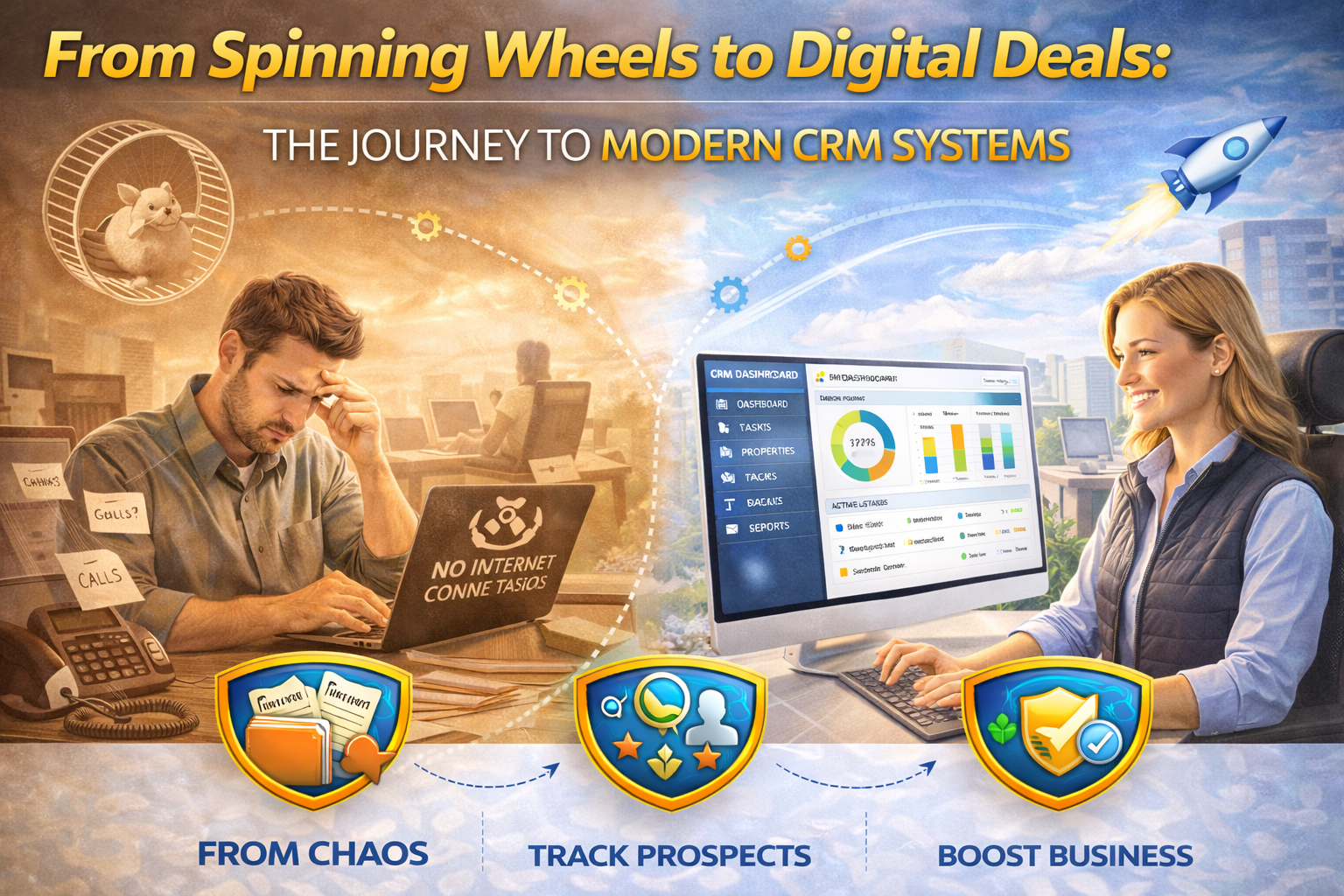
How did we go from paper cards to cloud-based power? Explore the history of real estate tech and why Modern CRM Systems are essential for today’s brokers.
Table of Contents
I recently found an old Rolodex tucked away in the back of a storage closet at a legacy brokerage office in Mumbai. It was a relic—a spinning wheel of yellowed cards, covered in scribbled phone numbers and coffee stains. Looking at it, I couldn’t help but feel a wave of nostalgia, but also a shudder of anxiety. I remembered the days when “losing your cards” meant losing your entire business. If that wheel fell off your desk, your local real estate market presence practically vanished overnight.
For decades, that was the gold standard. We relied on memory, ink, and a lot of luck. But as the housing market grew more complex and the pace of communication accelerated, the old ways started to crumble. We moved through the era of basic spreadsheets and clunky desktop software, eventually landing where we are now. Today, Modern CRM Systems aren’t just digital address books; they are the heart of a successful real estate operation. They manage everything from lead generation to the final closing documents, ensuring that no detail—and no client—is ever forgotten.
The Era of the Spinning Card
Back in the day, a real estate agent’s value was quite literally measured by the thickness of their Rolodex. If you wanted to find property listings or connect with real estate investors, you had to know the right person who had the right card. It was a manual, high-friction environment. There was no such thing as “automated follow-up.” If you didn’t remember to flip to a certain card and pick up the rotary phone, that lead was as good as dead.
As we moved into the 1980s and 90s, the first digital shift happened. Database software like ACT! started to replace the paper wheel. However, these weren’t yet the Modern CRM Systems we recognize today. They were siloed, lived on a single heavy computer, and didn’t talk to anything else. If your hard drive crashed and you hadn’t backed up your floppy disks, you were back to square one.
The Jump to the Cloud
The real revolution happened when software left the desktop and moved to the “cloud.” This was the birth of the early Modern CRM Systems. Suddenly, an agent could access their client data from a laptop at a kitchen table during a listing appointment, rather than having to drive back to the office.
This change was monumental for property management and sales alike. It meant that a broker could see what their team was doing in real-time. It also introduced the concept of the “drip campaign”—the ability to send a series of scheduled emails to prospective buyers without having to type each one manually. These Modern CRM Systems started to turn real estate from a game of memory into a game of systems.
Why Modern CRM Systems Are Non-Negotiable Today
We no longer live in a world where you can afford to wait three days to respond to an inquiry. Today’s buyers expect an answer in minutes. Without Modern CRM Systems, that level of responsiveness is physically impossible for a busy agent.
These systems now act as a virtual assistant that never sleeps. They can:
- Automatically capture leads from your website or social media.
- Track which properties a client is viewing in real-time.
- Set reminders for every contingency deadline in a contract.
- Store high-resolution photos and property disclosures in a secure, shared space.
According to data often discussed by the National Association of Realtors (NAR), agents who use a CRM consistently see a significant increase in their annual income. The difference between a “good” year and a “great” year often comes down to the efficiency of your Modern CRM Systems.
Integrating the Whole Transaction
One of the biggest shifts in recent years is how Modern CRM Systems have integrated the entire lifecycle of a deal. It’s no longer just about the “contact.” It’s about the transaction.
When you use Modern CRM Systems in a professional brokerage, you are connecting the dots between your marketing, your sales, and your back-office accounting. When a lead turns into an active buyer, the system moves them through the pipeline. When the offer is accepted, it triggers the escrow timeline. When the deal closes, it automatically sends a “Thank You” gift and schedules a follow-up call for one year later. This “lifecycle management” is what allows a solo agent to handle the volume of a small team.
For a deeper look at how these management structures have evolved, Wikipedia’s entry on Customer Relationship Management provides an excellent historical overview. It’s fascinating to see how the software moved from simple data storage to the complex, predictive Modern CRM Systems we use today.
The Human Element in a Digital World
A common fear among “old school” agents is that Modern CRM Systems make the business feel cold or robotic. I actually believe the opposite is true. By automating the boring, administrative tasks, these systems free up your time to actually be human.
You aren’t spending three hours a day data-entering phone numbers; you’re spending three hours a day on the phone or at coffee shops, building actual relationships. The best Modern CRM Systems actually help you be more personal. They remind you that it’s a client’s daughter’s birthday or that they recently mentioned they were looking for a home with a specific garden style. That’s not robotic—that’s being a better, more attentive advisor.
As noted by the Lincoln Institute of Land Policy, the digital transformation of land-use services is making data more accessible and necessary than ever. In this environment, Modern CRM Systems are the only way to keep your head above water.
Choosing Your Tech Stack
The market is flooded with options right now. From “all-in-one” platforms to specialized tools for niche markets, choosing among Modern CRM Systems can feel overwhelming. My advice? Don’t buy the most expensive one just because it has the most features. Buy the one your team will actually use.
A simple system that is used 100% of the time is infinitely more valuable than a complex one that sits idle. The most successful Modern CRM Systems are those that fit seamlessly into an agent’s existing workflow. They should be mobile-friendly, intuitive, and—most importantly—save you more time than they take to maintain.
FAQ Section
What is the main difference between a basic database and Modern CRM Systems? A basic database just stores information, like a digital Rolodex. Modern CRM Systems are active; they automate workflows, send emails, track client behavior, and integrate with other tools like your calendar and your marketing platforms.
Are Modern CRM Systems difficult for “non-techy” agents to learn? While there is a learning curve, most Modern CRM Systems today are designed with a “user-first” approach. They are often as intuitive as a smartphone app. Most companies also offer extensive training and “onboarding” to help you get started.
Can Modern CRM Systems help with lead generation? Absolutely. Many Modern CRM Systems have built-in tools to capture leads from your website, Facebook, and Instagram. They can also “score” your leads, telling you which ones are most likely to buy or sell soon based on their digital activity.
Is my client data safe in Modern CRM Systems? Yes. Reputable Modern CRM Systems use enterprise-level encryption and secure cloud storage. This is much safer than keeping client data on a physical piece of paper or an unencrypted spreadsheet on your laptop.
How much do Modern CRM Systems typically cost? Prices vary widely. You can find basic versions for under $50 a month, while enterprise-level Modern CRM Systems for large brokerages can cost thousands. The key is to find the one that offers the best ROI for your specific business size.
Conclusion
The journey from the spinning Rolodex to Modern CRM Systems hasn’t just been a change in technology; it’s been a change in how we think about our clients. We’ve moved from “owning a list” to “managing a relationship.”
In the competitive world of real estate, your ability to provide a seamless, organized, and personalized experience is what sets you apart. Modern CRM Systems are the tools that make that experience possible. They take the chaos of the market and turn it into a manageable, profitable business. If you’re still clinging to that old spinning wheel—or even just a messy spreadsheet—it’s time to step into the future.
