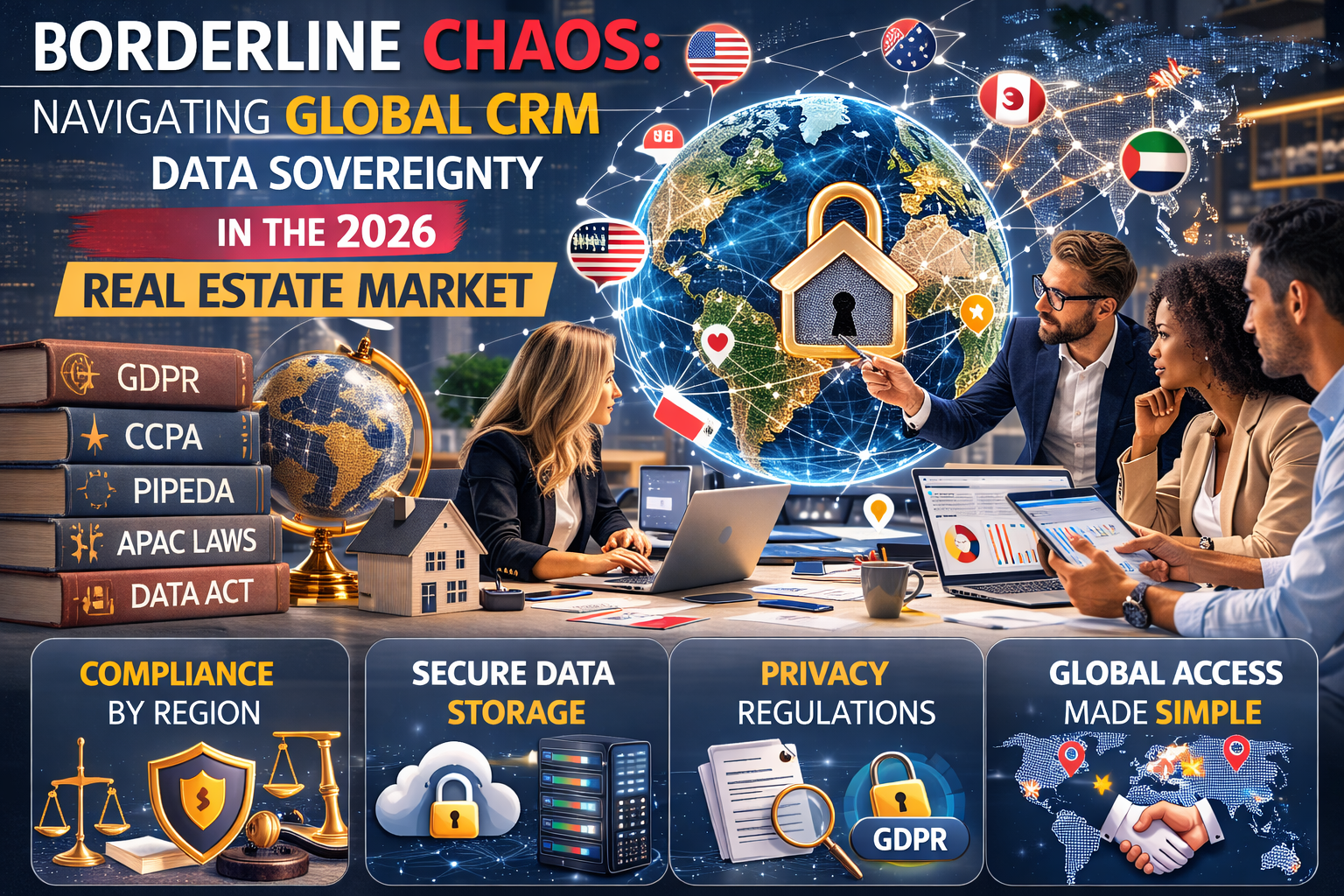
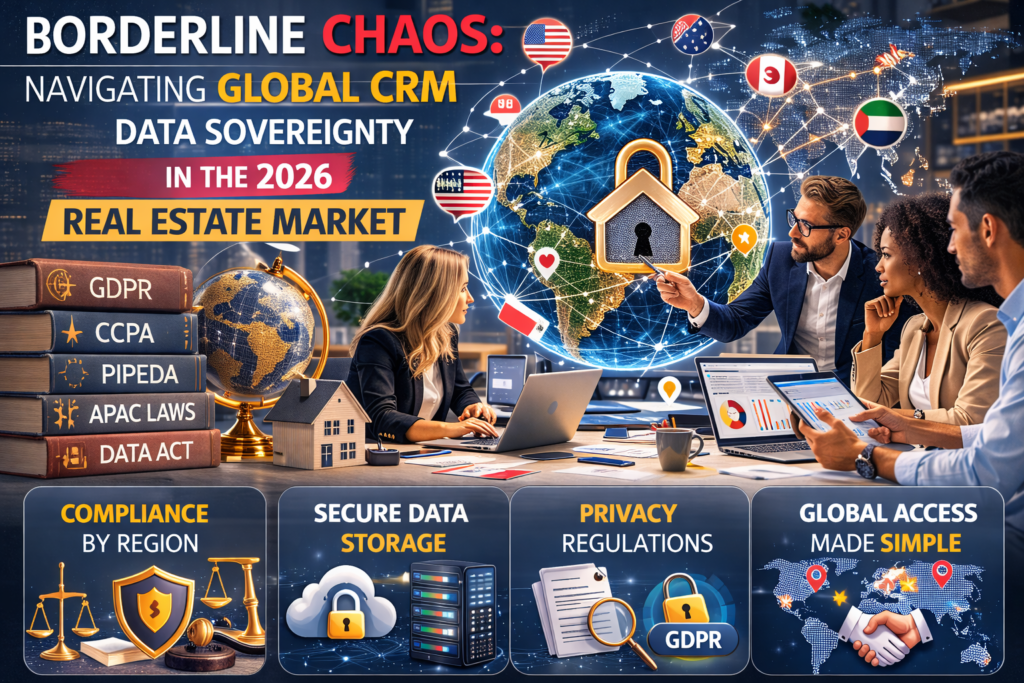
Is your client data crossing borders illegally? Master Global CRM Data Sovereignty in 2026 to protect your real estate brokerage from massive regulatory fines.
Table of Contents
I was catching up with a broker in London last month who specializes in ultra-high-net-worth real estate investors. He’s the kind of guy who can find a penthouse in Mayfair before it even hits the private market. But he wasn’t talking about commissions or interest rates. He was sweating over a letter from a regulatory body regarding where his client’s financial records were physically sitting.
“I thought the cloud meant my data was everywhere,” he told me. “Turns out, if it’s in the ‘wrong’ everywhere, I’m in deep trouble.”
Welcome to 2026. If you thought GDPR was a headache back in the day, the current landscape of Global CRM Data Sovereignty is a full-blown migraine for anyone doing international business. In real estate, we’re not just selling houses; we’re managing massive amounts of highly sensitive personal and financial information. If you have a buyer from Berlin, a seller from Singapore, and a CRM server in Seattle, you are likely standing on a legal landmine.
Understanding Global CRM Data Sovereignty isn’t just for the IT department anymore; it’s a core requirement for the modern real estate professional. It’s the principle that digital data is subject to the laws and governance of the country in which it is physically located. In 2026, where your data “lives” is just as important as where your clients live.
The Fragmentation of the Digital World
For years, we operated under the assumption that the internet was a borderless frontier. That era is officially over. We’ve moved into a period of “digital protectionism,” where over 140 countries now have their own unique data residency requirements.
When we talk about Global CRM Data Sovereignty, we’re talking about a patchwork of overlapping—and sometimes conflicting—obligations. For example, the EU’s updated Data Act now places heavy emphasis on data portability and reducing foreign jurisdictional access. If your Global CRM Data Sovereignty strategy doesn’t account for the fact that a U.S. court could theoretically compel a U.S.-based cloud provider to hand over a French citizen’s data, you are at risk of violating the “Schrems II” judgments that have become even more strictly enforced this year.
Why Real Estate is a High-Risk Niche
In real estate, our transactions are heavy with “provenance.” We track where the money came from, who owns the deed, and the intimate details of a family’s lifestyle. This makes us a prime target for regulators who are increasingly aggressive about enforcement.
If you are a brokerage handling cross-border real estate transactions, your CRM is the “black box” of your business. If that box is stored in a jurisdiction with lax privacy laws, your high-end clients—who value discretion above all else—will look for a firm that can prove their data is “geofenced” within their own borders. In 2026, an Global CRM Data Sovereignty certificate is becoming as essential as a professional license.
According to the National Association of Realtors (NAR), data security is now a top-three concern for international property buyers. They aren’t just worried about hackers; they are worried about government overreach and legal gray areas. Mastering Global CRM Data Sovereignty allows you to tell a trust story that your competitors simply can’t match.
The Rise of Sovereign Cloud and Local Hosting
To combat these legal hurdles, we’ve seen a massive shift toward “Sovereign Cloud” offerings. These are cloud environments that are jurisdictionally controlled. If you’re using a CRM that offers a sovereign cloud option, your data stays within the legal “walls” of your country.
For a mid-sized brokerage, this might mean choosing a provider that has data centers in your specific region. If you’re operating in the Asia-Pacific market, you need to ensure your Global CRM Data Sovereignty protocols align with the rapid APAC privacy expansion we’ve seen over the last year. Vietnam, for instance, recently formalized strict data subject rights and transfer restrictions that went into effect on January 1, 2026.
For a deeper dive into the legal distinctions that govern these spaces, Wikipedia’s entry on Data Sovereignty provides an excellent foundation. It explains why “residency” (where the data sits) is not the same as “sovereignty” (who has the legal right to access it). Understanding this distinction is the first step in building a compliant Global CRM Data Sovereignty framework.
Managing the “Data Gravity” Problem
There is a concept in tech called “data gravity.” It means that once you start piling data into a specific location, it becomes incredibly difficult and expensive to move it. If you choose a CRM provider today without a clear Global CRM Data Sovereignty plan, you might find yourself “locked in” to a jurisdiction that becomes legally toxic for your business next year.
Before you scale your international real estate business, you must audit your data flows.
- Map your ingestion: Where are your leads coming from?
- Identify your processors: Who is actually handling your data?
- Check the sub-processors: Even if your CRM is local, are they using a third-party analytics tool based in a different country?
As noted by the Lincoln Institute of Land Policy, the digital transformation of land-use services is making jurisdictional awareness a standard for all successful property ventures. Your Global CRM Data Sovereignty is the foundation on which your global expansion is built.
Protecting Trust: The ROI of Compliance
At the end of the day, real estate is a trust business. You fill the “trust bucket” one drip at a time, but you can tip it over with a single regulatory incident. A $4 billion EUR fine under GDPR isn’t just a number; it’s a business-ending event for most firms.
By proactively addressing Global CRM Data Sovereignty, you aren’t just avoiding fines. You are demonstrating to your investors, your lenders, and your high-value clients that you are a sophisticated operator. You’re signaling that their privacy isn’t just a checkbox on a form—it’s a core value of your brand. In the divided and fragmented market of 2026, Global CRM Data Sovereignty is the ultimate differentiator.
FAQ Section
What is the difference between data residency and Global CRM Data Sovereignty? Data residency is simply the physical location of the server (the postal code of the data center). Global CRM Data Sovereignty refers to the legal authority and technical control over that data based on the laws of the country where it is stored or processed.
How does Global CRM Data Sovereignty affect my real estate team’s daily workflow? It might limit the “tools” your team can use. For example, you may not be able to use certain third-party AI assistants if they process data in a jurisdiction that doesn’t meet your local sovereignty standards. Your CRM must be able to prove “region-aware” processing.
Is it expensive to move to a sovereign cloud CRM? There is often a premium for localized or sovereign cloud services compared to generic “hyperscale” platforms. However, you have to weigh that cost against the potential multi-million dollar fines for non-compliance. Most brokers find that Global CRM Data Sovereignty is a mandatory business expense in 2026.
Does Global CRM Data Sovereignty apply if I only have one office? It depends on where your clients are from. If you are a brokerage in New York but you are processing the personal data of a citizen of the European Union, you are likely subject to EU laws regarding Global CRM Data Sovereignty, regardless of where your physical office is located.
What should I ask my CRM vendor about data sovereignty? Ask for written evidence of “geofencing” and network routing. Inquire about their sub-processor disclosures and whether they hold ISO 27018 certification for cloud privacy. Ensure they have a clear plan for complying with the latest Global CRM Data Sovereignty regulations in your specific markets.
Conclusion
The era of “set it and forget it” data management is dead. In 2026, your business is defined by your ability to navigate the complex world of Global CRM Data Sovereignty. It’s a fast-moving target, but it’s one you can’t afford to miss.
Take the time to audit your systems today. Don’t wait for a regulatory letter to find out your data is in the “wrong” everywhere. By mastering Global CRM Data Sovereignty, you protect your business, you respect your clients, and you build a more resilient, professional brand for the future.
