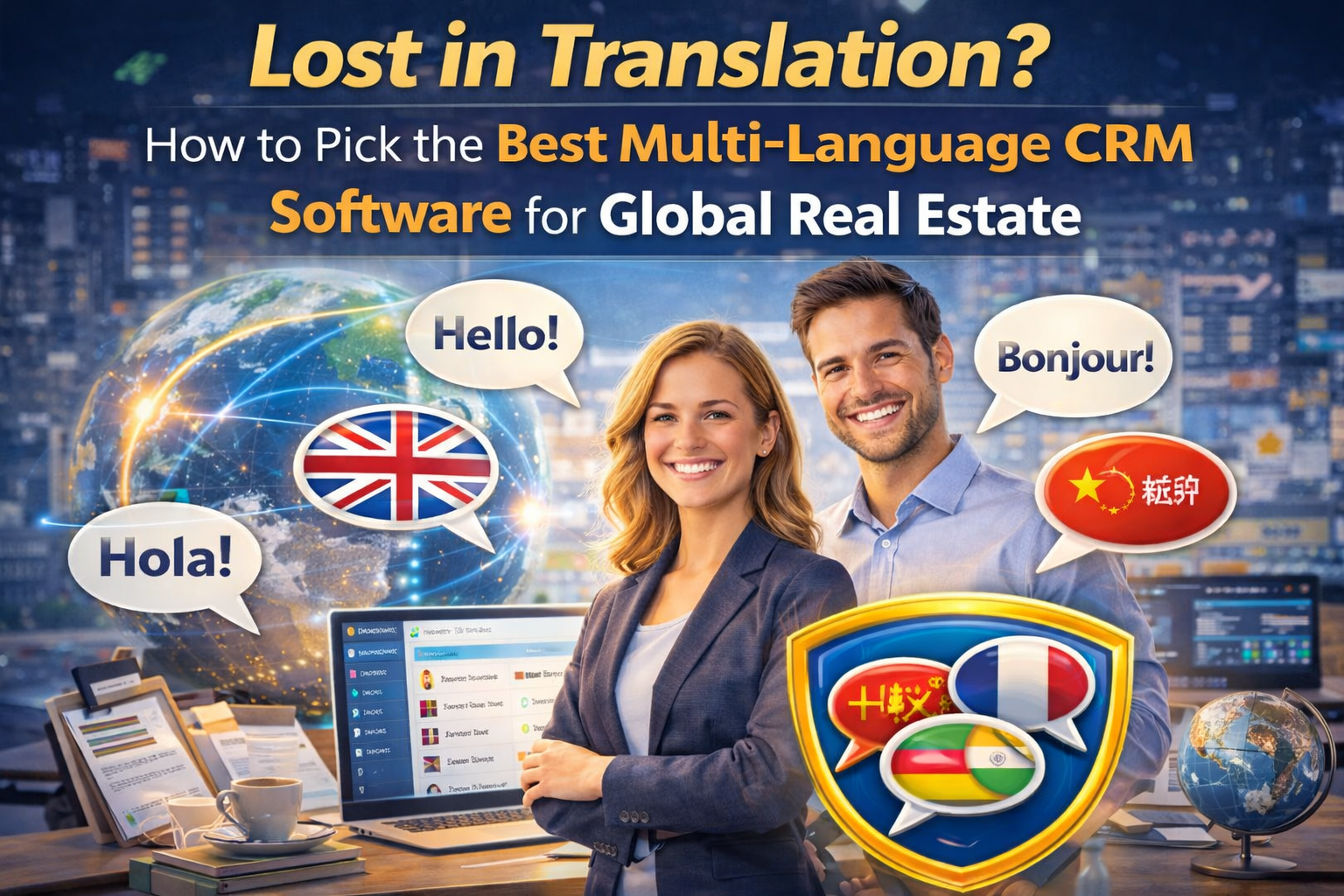
Don’t let language barriers kill your deals. Learn how to choose a Multi-Language CRM Software to unite your global team and serve international buyers.
Table of Contents
I’ll never forget a meeting I had back in 2023 with a brokerage owner who was trying to coordinate a massive cross-border deal between a development group in Dubai and a family office in Madrid. He was brilliant at identifying luxury residential assets, but his back-office was a disaster. His Spanish team was logging notes in one system, his Middle East desk was using another, and half the lead data was getting mangled in translation.
“We’re losing millions in the gaps,” he told me. “My agents can’t talk to each other, and my data is a Tower of Babel.”
In the high-stakes world of global property sales, your tech stack shouldn’t be a barrier; it should be a bridge. If you’re managing a team that spans different continents, or even just a diverse local market like Miami or London, a standard “English-only” database is a liability. You need a Multi-Language CRM Software that allows every agent to work in their native tongue while keeping the master data unified and accessible.
Choosing a Multi-Language CRM Software isn’t just about a “translate” button. It’s about cultural nuance, regional compliance, and ensuring that a lead captured in Mandarin can be seamlessly serviced by an agent in Paris. When your team can work comfortably in their own language, their productivity skyrockets, and your global real estate footprint becomes a lot more solid.
Why Your International Team is Struggling Without the Right Tools
The real estate industry is fundamentally built on relationships, and relationships are built on communication. If your agents are struggling to navigate a complex user interface because it’s not in their primary language, they’re going to take shortcuts. They’ll stop logging detailed notes, they’ll ignore lead scores, and they’ll eventually revert to using personal spreadsheets.
A specialized Multi-Language CRM Software eliminates this “digital friction.” It allows your Tokyo office to manage property listings in Japanese while your New York headquarters views the same data in English. This synchronization is vital for maintaining a “single source of truth” across your entire portfolio. Without a Multi-Language CRM Software, you aren’t running a global firm; you’re running a collection of disconnected islands.
Essential Features of a Global-Ready System
When you’re vetting a Multi-Language CRM Software, you need to look past the surface level. A truly international system needs to handle more than just text translation.
1. Right-to-Left (RTL) Support
If you have teams in the Middle East, your Multi-Language CRM Software must support RTL scripts like Arabic or Hebrew. If the interface just flips the text but keeps the layout left-justified, it becomes an ergonomic nightmare for the user.
2. Localization of Currencies and Units
Real estate investors in Europe want to see square meters and Euros; buyers in the US want square feet and Dollars. A top-tier Multi-Language CRM Software should automatically toggle these units based on the user’s locale, ensuring that a commercial real estate pitch makes sense to the person reading it.
3. Regional Compliance and Data Residency
International laws like GDPR in Europe or the Data Act in India mean you can’t just store data anywhere. Your Multi-Language CRM Software should help you navigate these regional “sovereignty” rules so you don’t end up with a massive regulatory fine.
According to data often cited by the National Association of Realtors (NAR), international buyers accounted for billions in US residential sales alone last year. To capture that market, your Multi-Language CRM Software needs to be as cosmopolitan as your clientele.

Improving the Buyer Journey Across Borders
The magic happens when the Multi-Language CRM Software works for the client, not just the agent. Imagine a prospective buyer from Beijing browsing your luxury listings. They fill out a form in Simplified Chinese. Your Multi-Language CRM Software should be able to route that lead to a Mandarin-speaking agent while providing a translated summary to the sales manager in London.
This level of “hidden” translation is what creates a professional, high-touch experience. It shows the buyer that you are a truly global player. When your Multi-Language CRM Software handles the linguistics, your agents can focus on the “Experience and Expertise” that actually closes the deal.
For a deeper look at the technical evolution of these global systems, Wikipedia’s entry on Internationalization and Localization provides a great breakdown of how software is adapted for different regions. In our industry, the Multi-Language CRM Software is the ultimate localization tool.
Managing Real Estate Investors and Multi-National Portfolios
If you deal with institutional real estate investors, you know they demand precision. They are often managing assets across multiple time zones and jurisdictions. A Multi-Language CRM Software allows you to provide them with a unified portal where they can view their global holdings in the language of their choice.
Whether it’s tracking rental yields in Berlin or cap rates in Singapore, having a Multi-Language CRM Software ensures that the data is consistent across the board. It prevents the “version control” issues that happen when different offices try to maintain their own localized reports. As noted by the Lincoln Institute of Land Policy, the digital transformation of land-use services is making global data transparency a requirement for modern property ventures.
Overcoming the “Cultural Gap” in Your CRM
Language is just the beginning. Different cultures have different ways of doing business. In some markets, a “lead” is someone who has already been vetted; in others, it’s just a casual inquiry. Your Multi-Language CRM Software should allow you to customize workflows to match these regional styles.
By using a flexible Multi-Language CRM Software, you can allow your Italian team to follow their traditional “high-touch” relationship-building process while your Silicon Valley team follows a high-velocity, automated drip sequence. The software should adapt to the team, not the other way around. This flexibility is what makes a Multi-Language CRM Software a strategic asset rather than just an administrative tool.
Checklist for Choosing the Best Multi-Language CRM Software:
- Language Coverage: Does it support the specific dialects and scripts your team uses?
- Real-Time Translation: Can it translate incoming lead notes on the fly?
- Time Zone Awareness: Does it automatically adjust follow-up reminders for different regions?
- Regional App Stores: Is the mobile app available in the local app stores for your international offices?
- Localized Support: Can your agents get technical help in their own language?
FAQ Section
Does a Multi-Language CRM Software translate my emails automatically? Many modern systems offer integration with translation services that can provide a “draft” translation of incoming emails. However, for a high-stakes real estate transaction, we always recommend a human review of the final outgoing message to ensure no nuance is lost.
Is Multi-Language CRM Software more expensive than standard versions? Generally, yes. There is a premium for the engineering required to support multiple scripts and regional localizations. However, the ROI comes from the increased productivity of your international teams and the higher conversion rates of global leads.
How does a Multi-Language CRM Software handle different address formats? A well-designed Multi-Language CRM Software will have a “flexible” address field that adapts to the country selected. It won’t force a French agent to use a US-style “State and Zip Code” format for a property in Lyon.
Can I set different languages for different users in one office? Yes! A key feature of Multi-Language CRM Software is “per-user” settings. This is perfect for a diverse office in a city like Toronto or Dubai, where agents might prefer to work in English, Spanish, or Arabic while sharing the same database.
Does using a Multi-Language CRM Software help with SEO? If your CRM powers your website’s property listings, then yes. A Multi-Language CRM Software that can export data in multiple languages allows you to rank for keywords in different languages, attracting more international search traffic to your listings.
Conclusion
At the end of the day, the world is getting smaller, but the complexity of global real estate is only growing. You can’t expect to compete in the 2026 market using tools built for 1996. A Multi-Language CRM Software is a requirement for any firm that wants to be taken seriously on the international stage.
By uniting your team under one digital roof, regardless of what language they speak, you create a more resilient and efficient business. You stop the “data leakage” that happens in translation and start building a truly global brand. Don’t let a language barrier be the reason you miss out on the next big cross-border deal.
