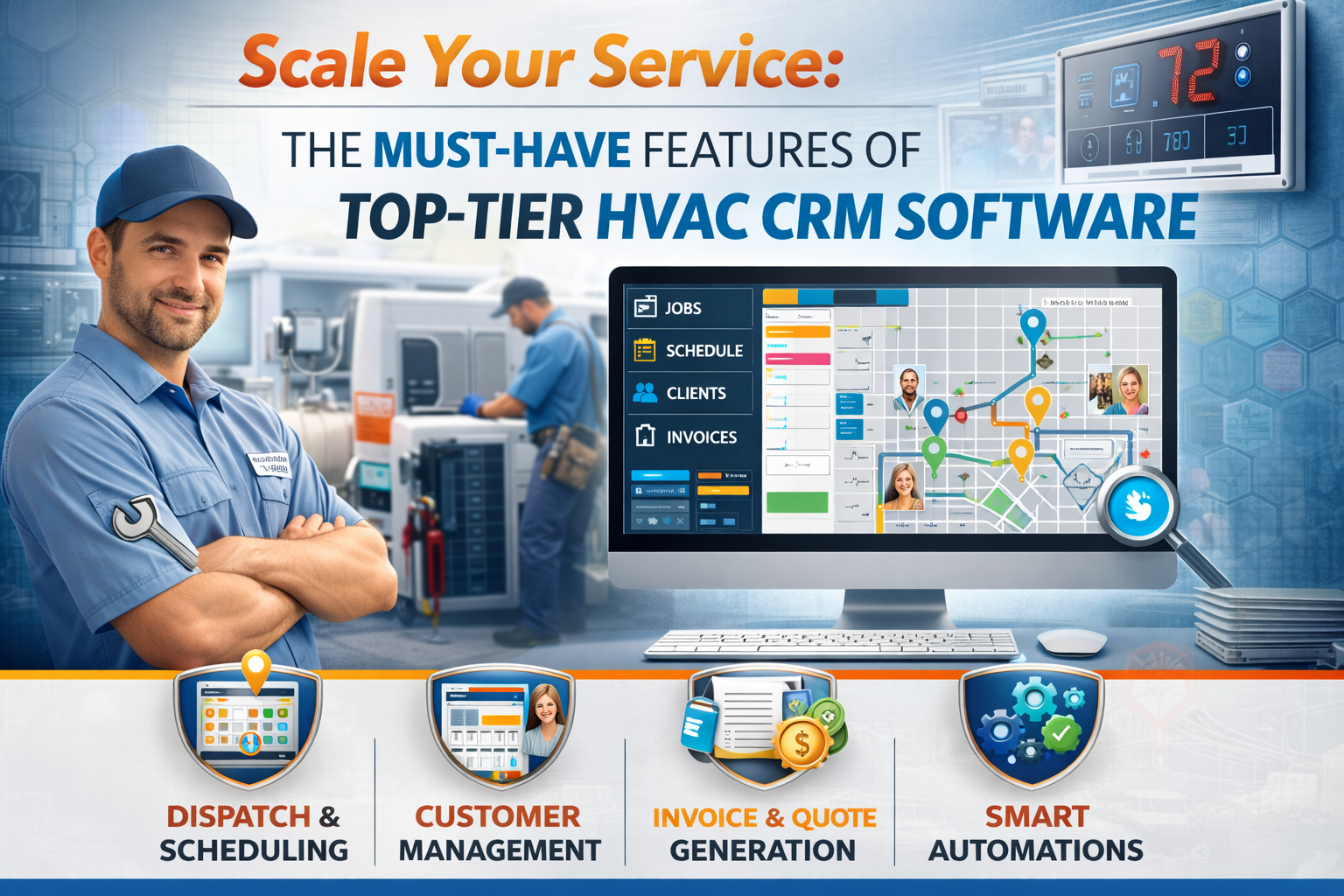
Tired of scheduling headaches? Discover the essential features to look for in HVAC CRM Software to streamline your dispatching and boost your bottom line.
Table of Contents
I’ll never forget a conversation I had with a local HVAC contractor named Dave. He’d been in the business for twenty years, running a tight ship with a few vans and a mountain of clipboards. He was a master of his craft, but his office was a graveyard of yellow carbon-copy invoices and sticky notes that seemed to lose their stickiness right when he needed a customer’s phone number. Dave was working fourteen-hour days, not because he was fixing furnaces, but because he was chasing paperwork.
This is the “success trap” in the trades. You’re good at what you do, so you get more calls, but then the administrative weight of managing those calls starts to crush your actual productivity. If you are still relying on a whiteboard and a prayer to manage your field technicians, you aren’t just wasting time; you are actively bleeding profit.
In the modern real estate and service market, moving to a specialized HVAC CRM Software is the single most important pivot you can make. It’s the digital backbone that connects your office, your trucks, and your customers. But with so many options hitting the market, how do you know which one is actually going to make your life easier and which one is just another monthly subscription fee? Let’s dive into the features that truly move the needle.
The Heart of the Operation: Intelligent Dispatching
The most immediate “pain point” for any heating and air company is the morning scramble. Who goes where? Who has the right parts on their truck? When you implement HVAC CRM Software, the chaos of manual scheduling vanishes.
You need a system that offers a drag-and-drop dispatch board. It should give your office staff a bird’s-eye view of where every van is located in real-time. If a high-priority emergency call comes in from a property manager with a flooded basement or a broken chiller, the software should show you exactly which tech is closest and has the lightest schedule for the afternoon.
- GPS Integration: No more “Where are you?” calls to your drivers.
- Skill-Based Routing: Ensure your senior tech goes to the complex boiler repair while the apprentice handles the routine filter changes.
- Instant Tech Updates: The moment a job is assigned in the HVAC CRM Software, the technician gets a push notification with the full customer history.
Mobile Empowerment for Field Technicians
Your techs are your frontline. If they have to drive back to the office to drop off a signed invoice or pick up a new work order, you are losing billable hours. A top-tier HVAC CRM Software must have a robust mobile app that works as well in a signal-dead basement as it does in the office.
The app should allow them to take “before and after” photos, which are vital for residential real estate disclosures. If a homeowner is selling their property, having a digital trail of every maintenance call and repair performed on the system adds immense value to the listing. It builds trust with potential buyers and provides the “Experience and Expertise” that modern real estate transactions demand.
According to data often discussed by the National Association of Realtors (NAR), well-documented mechanical systems are a major selling point. When your HVAC CRM Software makes it easy for your tech to generate a professional, branded PDF report on-site, you are providing a premium service that justifies a premium price.
Automated Maintenance Agreements
The “holy grail” of the HVAC world is recurring revenue. You don’t want to wait for the phone to ring when it hits 90 degrees; you want a steady stream of “pre-season” tune-ups.
Your HVAC CRM Software should act as a proactive salesperson. It should automatically track your maintenance contracts and send out reminders to customers when their biannual service is due. This “set it and forget it” approach ensures that your schedule stays full during the “shoulder seasons” when the weather is mild.
I’ve seen small firms double their valuation simply by organizing their maintenance agreements within a solid HVAC CRM Software. When it comes time to sell your business or seek investment, a clean, digital list of recurring contracts is far more valuable than a drawer full of paper files. For more on the technical side of managing these client relationships, Wikipedia’s entry on Customer Relationship Management offers a great foundation on how these systems evolved for specialized trades.
Seamless Invoicing and On-Site Payments
Let’s talk about the “cash-to-cash” cycle. If you wait until Friday to input all your invoices, you are essentially giving your customers a 5-day interest-free loan. The best HVAC CRM Software allows your technicians to generate the invoice and collect payment right there at the kitchen table.
By integrating with mobile card readers, your team can close out the job and have the funds hitting your bank account before they’ve even pulled out of the driveway. This immediate billing reduces the administrative burden on your office staff and virtually eliminates the “I forgot to pay that bill” follow-up calls.
Integration with Accounting Tools
You don’t want to be entering data twice. Your HVAC CRM Software must play nice with your accounting platform, whether that’s QuickBooks or Sage. A one-click sync saves hours of manual entry and ensures that your tax filings are accurate and painless. It’s about creating a “closed-loop” system where every dollar is tracked from the moment the lead comes in until the tax return is filed.
Marketing and Lead Tracking
How much does it cost you to get a new customer? If you don’t know that number, you are flying blind. A specialized HVAC CRM Software will track where your leads are coming from—whether it’s a Google ad, a referral from a local Realtor, or the wrap on your van.
This data allows you to spend your marketing budget where it actually works. If you see that your best high-ticket installations are coming from a specific neighborhood, you can target your direct mail or social ads accordingly. The “Customer” part of HVAC CRM Software isn’t just about service; it’s about growth.
As noted by the Lincoln Institute of Land Policy, the digital transformation of urban services is accelerating. Using a professional HVAC CRM Software puts you ahead of the curve, allowing you to provide the same level of digital convenience that customers expect from Amazon or Uber.
Essential Features Checklist
When you are doing your demos and trials, keep this checklist of HVAC CRM Software essentials in mind:
- Customer Portal: Allow homeowners to book appointments and view their service history online.
- Inventory Management: Track every capacitor and motor across your entire fleet so you never send a tech to a job without the right part.
- Automated Follow-ups: Send a “How did we do?” survey after every job to boost your online reviews.
- Photo and Video Attachments: Document the condition of the heat exchanger or the clogged condensate line for liability protection.
- Offline Functionality: Because, as we all know, furnaces always break in the one corner of the house with no Wi-Fi.
FAQ Section
Is HVAC CRM Software worth the cost for a one-man shop? Absolutely. In fact, it might be more important for a solo operator. When you are the tech, the dispatcher, and the accountant, you need the HVAC CRM Software to act as your virtual assistant. It keeps you organized so you can focus on the billable work.
How long does it take to get a team up and running? Most modern cloud-based systems can be configured in a few days. The “learning curve” for technicians is usually very short, especially if the mobile app is intuitive. The key is to start with the basics—dispatching and invoicing—and then layer in the advanced features of the HVAC CRM Software over time.
Can I use a generic CRM for my HVAC business? You could, but you’ll probably regret it. Generic platforms don’t understand things like “equipment history,” “flat-rate pricing,” or “refrigerant tracking.” A specialized HVAC CRM Software is built for the way you actually work in the field.
Does this software help with EPA compliance? Yes! Many high-end HVAC CRM Software options include built-in refrigerant tracking logs. This makes it much easier to stay compliant with EPA 608 regulations without having to manage a separate set of logbooks.
Will I lose my data if I decide to switch platforms later? Most reputable HVAC CRM Software providers allow you to export your customer lists and service history into a CSV or Excel format. Always check the “data ownership” clause in your contract before signing up.
Conclusion
At the end of the day, your HVAC business is about more than just fixing air conditioners. It’s about providing comfort, reliability, and professional service. The right HVAC CRM Software is the tool that allows you to deliver on those promises consistently.
Don’t let the paperwork “leak” your profits away. Take the time to find a platform that fits your team’s workflow and your growth goals. When you trade the clipboards for a tablet and a powerful HVAC CRM Software, you aren’t just modernizing your office—you are securing the future of your company. You’ll find yourself with more time, less stress, and a much healthier bottom line.
