
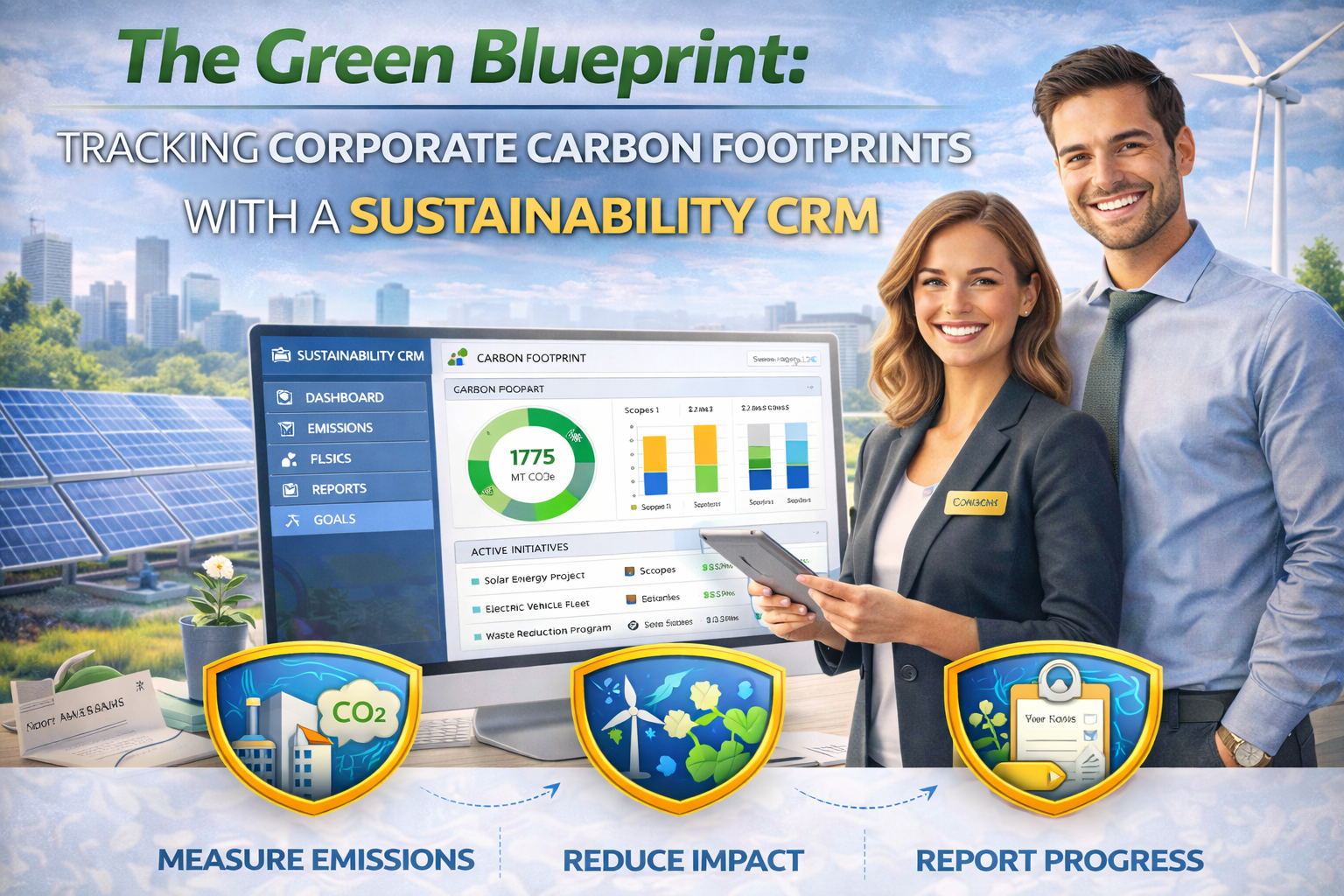
Struggle to measure your building’s environmental impact? Discover how a Sustainability CRM tracks carbon footprints to attract eco-conscious commercial tenants.
Table of Contents
I was touring a massive Class-A office building last month with a regional property management group. The architectural design was beautiful, the amenities were stunning, and the location was prime. Yet, the asset manager looked completely exhausted. He wasn’t stressed about occupancy rates or leasing timelines; he was overwhelmed by the sheer volume of environmental reporting.
Commercial tenants were demanding net-zero buildings, and his team was drowning in a sea of utility bills, water usage logs, and clunky carbon spreadsheets. It was a classic operational bottleneck that is becoming all too common in the industry.
In the modern commercial real estate space, managing environmental, social, and governance (ESG) goals manually is a recipe for failure. The stakes are simply too high, and the math is too complex. That is exactly why adopting a specialized Sustainability CRM is becoming mandatory for serious investors. This software takes the guesswork out of carbon accounting, giving real estate portfolios the exact data they need to stay competitive, compliant, and highly profitable.
Why Commercial Real Estate Needs a Sustainability CRM
For decades, facility managers just paid the energy bills, filed them away, and moved on to the next maintenance ticket. But the corporate landscape has fundamentally shifted. Major corporations, tech giants, and financial institutions now have strict, publicly declared environmental mandates.
If your building cannot unequivocally prove its energy efficiency, those blue-chip tenants will simply look elsewhere. They cannot afford to lease space in a building that drags down their own corporate ESG scores.
A Sustainability CRM acts as the central hub for your building operations. Rather than treating tenant relationships, lease management, and energy consumption as disconnected silos, this software merges them into a single, cohesive dashboard. You can track exactly how much power, water, and waste is tied directly to a specific commercial lease.
This granular data allows you to have meaningful, data-backed conversations with your commercial tenants about lowering their environmental impact. It transforms you from a simple rent-collector into a strategic green partner, deeply entrenching your value in their corporate journey.
Decoding Scope 1, Scope 2, and Scope 3 Emissions
If you are new to the world of carbon tracking, you will quickly run into the three “scopes” of greenhouse gas emissions. They can be confusing to navigate without the right digital infrastructure in place.
Scope 1 covers direct emissions from sources you own or control. In real estate, this usually means the natural gas burned by on-site boilers or the fuel used by company-owned maintenance vehicles. Scope 2 covers indirect emissions from purchased electricity, steam, heating, and cooling consumed by the reporting company.
Scope 3 is where things get notoriously messy. It includes everything else in your value chain, such as tenant commuting habits, waste disposal, and the “embodied carbon” of your building materials. A robust Sustainability CRM is designed to untangle this complex web of data. It automates data collection across all three scopes, ensuring nothing falls through the cracks and no metric is double-counted.
According to the U.S. Green Building Council (USGBC), accurately tracking these multifaceted metrics is a foundational requirement for achieving and maintaining LEED certification. Without accurate software, maintaining that coveted green building status is nearly impossible.
Implementing Green Leases Through a Sustainability CRM
One of the biggest trends in property management right now is the adoption of the “green lease.” These are specialized rental agreements where both the landlord and the tenant commit to specific environmental benchmarks and data-sharing protocols.
Historically, real estate has suffered from a “split-incentive” problem. The landlord pays for the expensive HVAC upgrades, but the tenant reaps the financial reward through lower monthly utility bills. Green leases fix this by creating structures to share both the capital costs and the resulting savings. But a contract is useless if you can’t measure the results.
When you manage your properties using a Sustainability CRM, you can set automated alerts for energy spikes. If a tenant leaves their lights on all weekend or runs their cooling system with the windows open, the system flags the anomaly. You can proactively address the issue, keeping everyone on target for their shared carbon goals.
This level of operational transparency builds incredible trust in the market. Institutional buyers and Wall Street funds are increasingly looking at real estate portfolios through a strict ESG lens. Being able to export a clean, verifiable carbon report from your Sustainability CRM makes your assets significantly more attractive to these high-level investors.
The End of Spreadsheet Chaos and Data Decay
Let’s face it: manual data entry is where catastrophic errors happen. If a tired intern accidentally adds an extra zero to a natural gas metric in a spreadsheet, your entire corporate carbon footprint calculation is ruined.
Worse yet, spreadsheets suffer from “data decay.” Formulas break, multiple versions of the same file get passed around via email, and historical context is lost when an employee leaves the company. It is a fragile system for managing multi-million-dollar assets.
Modern platforms eliminate this risk by integrating directly with utility providers and on-site smart meters. The Sustainability CRM pulls the raw consumption data in real-time, converts it into standardized carbon equivalents, and attaches it permanently to the correct tenant profile.
For a deeper understanding of how these corporate metrics are globally standardized, the Wikipedia entry on Carbon Footprint offers excellent context on greenhouse gas protocols and reporting frameworks. It underscores exactly why having a standardized, automated digital tool is critical for accurate reporting.
Leveraging Data for Better Building Operations
Tracking your carbon footprint isn’t just about saving the planet; it is fundamentally about saving money. Buildings that leak energy are quite literally burning cash out of the exhaust vents.
By deeply analyzing the consumption data within your system, facility managers can identify hidden operational inefficiencies before they become massive capital expenses. This moves a building’s maintenance strategy from a reactive posture to a proactive one.
Maybe the recent LED lighting retrofit in Tower A yielded a 20% drop in carbon emissions, while Tower B saw absolutely no change despite identical upgrades. Your Sustainability CRM highlights these operational anomalies, allowing you to deploy your maintenance teams exactly where they are needed most.
This proactive approach extends the lifespan of your mechanical systems, reduces emergency repair calls, and drastically lowers operating expenses. Ultimately, these savings flow directly to the bottom line, significantly increasing the Net Operating Income (NOI) and overall valuation of the property.
FAQ Section
What exactly is a Sustainability CRM? A Sustainability CRM is a specialized customer relationship management platform that integrates environmental data alongside traditional tenant data. It allows property owners to track tenant energy usage, carbon emissions, and lease compliance all within one centralized digital dashboard.
How does this software help with LEED certification and GRESB reporting? Achieving certifications like LEED or scoring well on the Global Real Estate Sustainability Benchmark (GRESB) requires meticulous documentation of energy efficiency and waste management. The software automates this heavy data collection, providing auditors with clean, verifiable reports that speed up the certification process.
Can it track indirect Scope 3 emissions for commercial tenants? Yes. A high-quality Sustainability CRM can track difficult indirect Scope 3 emissions by digitally surveying commercial tenants on their waste output, commuting habits, and supply chain impacts, seamlessly pulling it all into your master portfolio report.
Does it integrate with existing property management and accounting software? Most modern platforms are designed with open APIs and native integrations. This means they can seamlessly connect with your existing accounting software and legacy property management tools, preventing double data entry and keeping your back-office operations streamlined.
Will this software help me attract better commercial tenants? Absolutely. Fortune 500 companies and tech firms have strict corporate climate pledges. By utilizing a platform that provides them with transparent, accurate data regarding their office space, you make your building the easiest and most attractive choice for their corporate real estate teams.
Conclusion
The commercial real estate industry is currently undergoing a massive, irreversible green transformation. Tenants, investors, and local regulators are no longer accepting vague promises or glossy marketing brochures about environmental stewardship; they want hard, verifiable data.
The days of managing a building’s environmental impact on a yellow legal pad or a fragile spreadsheet are over. By adopting a Sustainability CRM, you protect the long-term value of your real estate portfolios and insulate your assets against future climate regulations.
If you want to future-proof your assets, a Sustainability CRM is the ultimate tool to get you there. You create a transparent, efficient, and highly desirable environment that modern commercial tenants are happy to pay a premium for.
