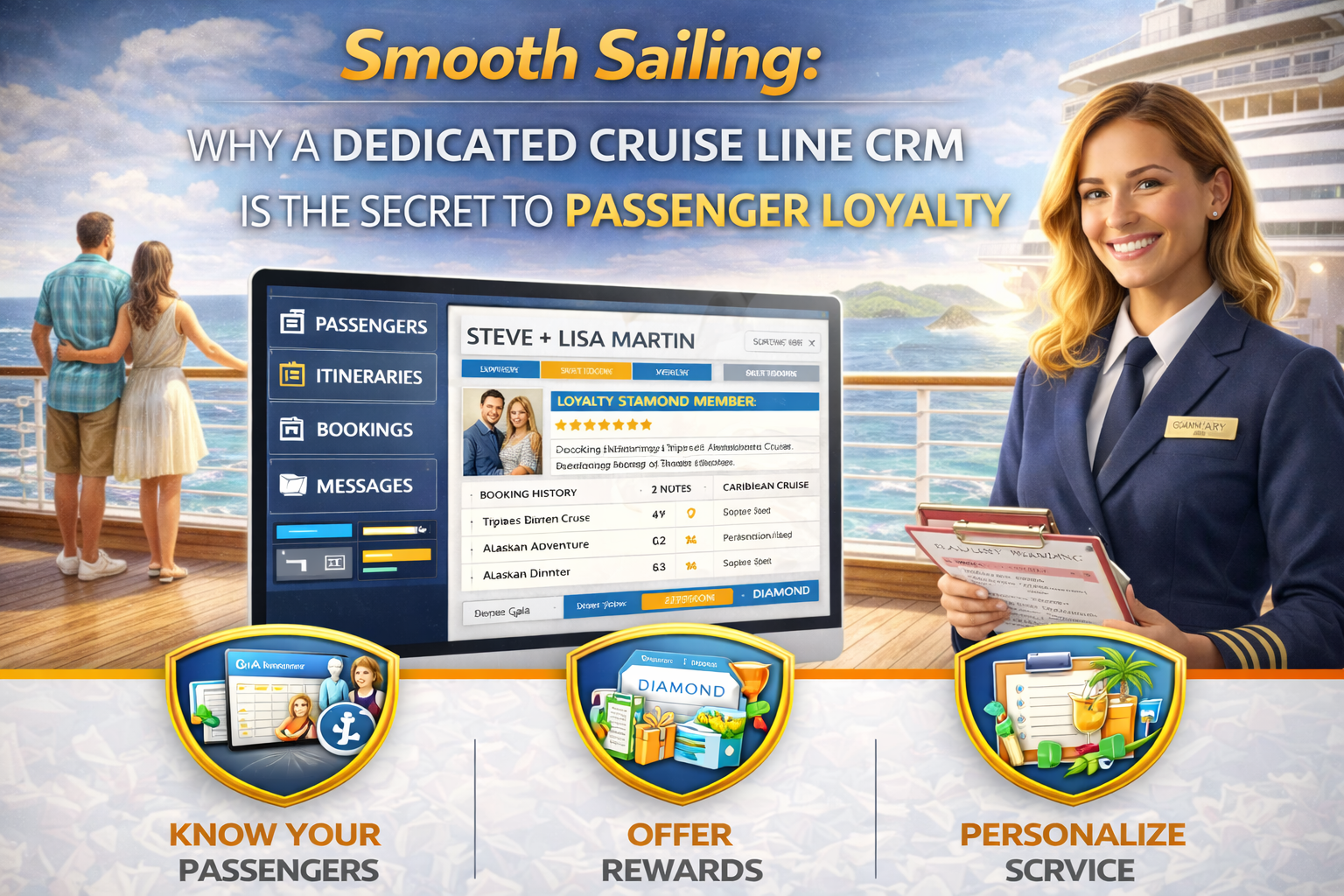
Stop losing travelers to the competition. Learn how a Cruise Line CRM personalizes the guest experience, manages bookings, and builds lifelong passenger loyalty.
Table of Contents
I’ll never forget a conversation I had with an old friend who manages a boutique portfolio of vacation rentals in the Caribbean. He told me that his biggest challenge wasn’t the maintenance or the marketing; it was the “silent departure.” This happens when a guest has a perfectly pleasant stay but simply never comes back because they didn’t feel a personal connection to the brand.
In the hospitality and real estate world, we call this a “leaky bucket.” You spend a fortune on lead generation and flashy advertisements to get people through the door, only to let them slip away because you didn’t have a system to remember their name, their preferences, or their history.
This is exactly why the maritime industry has pivoted so hard toward the Cruise Line CRM. On a ship that carries thousands of passengers, you can’t rely on a steward’s memory to provide “white-glove” service. You need a digital nervous system that tracks every interaction from the moment a traveler clicks on a Facebook ad to the day they walk off the gangplank. A dedicated Cruise Line CRM isn’t just a database; it’s a tool for emotional architecture. It’s what allows a massive vessel to feel like a private yacht for every individual on board, ensuring that the guest experience isn’t just a transaction, but a relationship worth repeating.
The High Stakes of the “Returning Guest” Model
In the real estate sector, we know that a returning tenant or a repeat buyer is worth ten new leads. The acquisition cost is lower, the trust is already established, and the sales cycle is significantly faster. The cruise industry operates on the exact same math.
A Cruise Line CRM allows an agency or a line to identify their “Power Fans”—those passengers who book every year and refer their friends. If you aren’t using a Cruise Line CRM to track these high-value individuals, you are essentially flying blind. You might be sending a generic “10% off” coupon to someone who would have booked a $10,000 suite if you had just acknowledged their preferred itinerary or their favorite vintage of wine.
By centralizing passenger data, a Cruise Line CRM ensures that your marketing is surgical rather than scattershot. You stop shouting at the crowd and start whispering in the ears of your most loyal customers. This level of personalization is what drives the high “Net Promoter Scores” that lead to long-term sustainability in a crowded market.
Personalization: The Key to Modern Maritime Luxury
Today’s traveler is savvy. They know their data is being collected, and in exchange, they expect a more tailored experience. They don’t want to be “Passenger 402B”; they want to be “Mr. Miller,” the guy who prefers extra pillows and has a severe shellfish allergy.
A specialized Cruise Line CRM stores these tiny but vital details. When a guest walks into a specialty restaurant on board, the host should already know their dietary restrictions because the Cruise Line CRM pushed that data to the point-of-sale system. This “invisible service” is the hallmark of modern luxury. It’s the same feeling a buyer gets when a Realtor remembers they need a home office with northern light—it builds an immediate sense of being “home.”
According to data often discussed by the National Association of Realtors (NAR), personalization is one of the top drivers of brand loyalty in the luxury residential and hospitality markets. By using a Cruise Line CRM to bridge the gap between the booking office and the ship’s crew, you create a seamless loop of care that passengers find nearly impossible to leave.
Streamlining the Booking and Documentation Maze
Let’s be honest: the paperwork involved in a cruise is a nightmare. You have passports, health declarations, excursion bookings, and shore side transfers. If these are scattered across twenty different email threads, you are inviting a logistical disaster.
A Cruise Line CRM serves as a secure, cloud-based vault for all this documentation. Your agents can see at a glance if a passenger hasn’t uploaded their visa yet, triggering an automated, friendly reminder. This reduces the friction of the pre-cruise experience, which is often where the most stress occurs.
For a deeper look at the administrative evolution of these systems, Wikipedia’s entry on Customer Relationship Management offers great context on how digital tools moved from simple sales trackers to full-scale operational partners. In the maritime world, your Cruise Line CRM is the “shore-to-ship” bridge that keeps the logistics from overshadowing the vacation.
Managing Real Estate and Cabin Inventory in Real-Time
A cruise ship is essentially a floating piece of high-density real estate. You have hundreds of “units” (cabins) that need to be occupied at a specific price point to ensure the voyage is profitable.
Your Cruise Line CRM should integrate directly with your inventory management system. This allows your sales team to offer “last-minute” upgrades to loyal passengers based on their previous spending habits. For example, if the Cruise Line CRM shows that a guest frequently spends on high-end spa treatments, you might offer them a discounted balcony suite to get them on board. As noted by the Lincoln Institute of Land Policy, the digital transformation of property and land usage is making real-time data the standard for all successful hospitality ventures.
Improving Post-Cruise Engagement and “The Long Tail”
The most important part of passenger loyalty happens after they leave the ship. This is where most brands fail. They send a “Thank you for sailing” email and then go silent for six months.
A sophisticated Cruise Line CRM keeps the conversation going. It can trigger an automated “Happy Birthday” message with a specific offer for their favorite destination. It can notify them when a ship they’ve sailed on before is returning to a nearby port. By staying top-of-mind through your Cruise Line CRM, you ensure that when they are ready to book their next vacation, yours is the first website they visit.
Key Features of a High-Performance Cruise Line CRM:
- Guest Profiles: Detailed histories of past sailings, spending habits, and cabin preferences.
- Automated Marketing: Tiered loyalty programs that reward “frequent floaters” automatically.
- Integrated Booking: A seamless path from a marketing email to a confirmed cabin reservation.
- Real-Time Analytics: Identify which itineraries are the most profitable and which demographics are most likely to re-book.
- Mobile Accessibility: Allow agents to close deals and manage passenger issues from anywhere.
The ROI of “Emotional” Data
I once saw a case where a line used their Cruise Line CRM to track “milestone” events. They identified a couple celebrating their 50th wedding anniversary on board. Because the CRM flagged this, the captain was able to send a hand-written note and a bottle of champagne to their cabin.
That couple didn’t just become loyal; they became evangelists. They posted photos of that note to their social media, reaching thousands of potential new leads. This is the “soft” ROI of a Cruise Line CRM. It’s about more than just numbers; it’s about capturing the human moments that create brand ambassadors. In the competitive real estate of the open seas, your brand’s reputation is your most valuable asset.
FAQ Section
Will a Cruise Line CRM be too expensive for a small charter company? Most CRM platforms offer tiered pricing. While a global line needs a massive enterprise solution, a smaller boutique charter can use a scaled-down Cruise Line CRM to manage their high-touch relationships. The return on investment usually comes through the reduction in manual labor and the increase in repeat bookings.
How does this integrate with the ship’s onboard systems? The best Cruise Line CRM options use APIs (Application Programming Interfaces) to “talk” to the ship’s Property Management System (PMS). This allows shore-side agents to see what a guest is doing in real-time—like booking an excursion or dining at a specialty restaurant—and use that data for future marketing.
Can I manage travel agent commissions in the same system? Yes. A professional Cruise Line CRM will track which agencies are driving the most traffic and ensure their commissions are calculated and paid accurately. This builds strong B2B relationships with the brokers who help fill your ships.
Is passenger data secure in a cloud-based CRM? Security is paramount. Dedicated Cruise Line CRM providers use enterprise-level encryption and are compliant with international data laws like GDPR. This is significantly safer for sensitive passport and credit card data than keeping it in unencrypted spreadsheets.
Does a Cruise Line CRM help with crisis management? Absolutely. If a voyage is cancelled or an itinerary is changed due to weather, the Cruise Line CRM allows you to communicate instantly with every passenger, offering re-booking options or credits immediately, which helps preserve brand trust during a difficult situation.
Conclusion
At the end of the day, a cruise line isn’t just selling a cabin; it’s selling a memory. You are asking people to trust you with their most valuable asset: their time. A Cruise Line CRM is the tool that ensures that trust is never misplaced.
By automating the administrative “noise,” you free up your team to focus on the “human” element of hospitality. Don’t let your passengers become just another row in a spreadsheet. Invest in the technology that allows you to see them as individuals, with their own stories, preferences, and dreams. When you organize your passenger loyalty through a Cruise Line CRM, you aren’t just buying software; you’re buying the future of your brand’s success.
