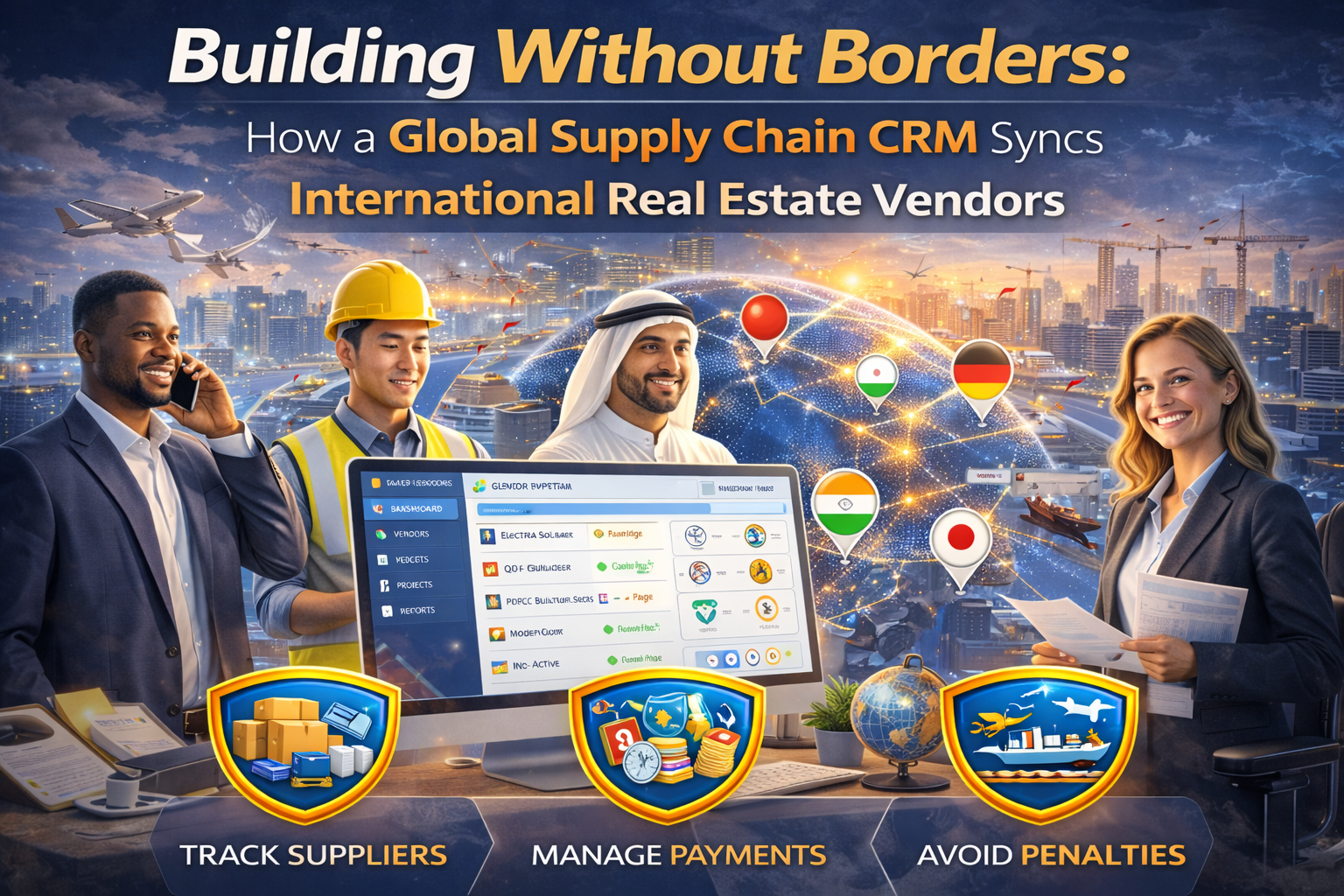
Tired of construction delays? See how a Global Supply Chain CRM unifies international vendors, secures material pipelines, and protects your real estate ROI.
Table of Contents
I was walking through a massive construction site for a new luxury high-rise in South Mumbai recently, and the site manager looked like he was about to pull his hair out. It wasn’t the heat or the local labor issues—it was the glass. A specific shipment of high-performance glazing from Germany was stuck in transit, and nobody could tell him exactly where the shipping container was or when it would clear customs.
“Every day we wait is a day we lose on the back end of our project timeline,” he told me, gesturing at the skeleton of the building. “And every lost day is eating into the investors’ equity.”
This is the hidden nightmare of modern, large-scale property development. We aren’t just buying local bricks and mortar anymore; we are sourcing high-tech HVAC systems from Japan, sustainable timber from Scandinavia, and smart-home components from Silicon Valley. When your logistics are scattered across ten different time zones and twenty different spreadsheets, you aren’t just building a property—you’re gambling with it.
This is exactly where a specialized Global Supply Chain CRM becomes the digital glue for your entire operation. It moves the focus from simple “customer” tracking to comprehensive “vendor” management. By unifying your cross-border relations, a Global Supply Chain CRM ensures that your project doesn’t grind to a halt because of a communication gap halfway across the world. It provides the transparency and real-time data needed to keep your real estate portfolios on track and your profit margins healthy.
The Chaos of Disconnected Vendor Networks
In the world of commercial real estate, a delay in a single material delivery can trigger a domino effect. If the flooring is late, the painters can’t start. If the painters can’t start, the staging company can’t move in. If the staging is delayed, your marketing launch and open house dates disappear.
Traditionally, we managed these relationships through a frantic series of emails, WhatsApp messages, and late-night international phone calls. But that is a fragile system. A Global Supply Chain CRM replaces that chaos with a single source of truth. It allows your procurement team in India to see exactly what the manufacturer in Italy has confirmed, without needing to wait for an email reply.
By centralizing these interactions, you eliminate the “he said, she said” disputes that often plague international contracts. The Global Supply Chain CRM records every specification, every lead time, and every shipping update. This level of organization is what builds “Experience and Trust” in a market that is increasingly skeptical of project delivery timelines.
Why Real Estate Development Needs Specialized CRM Logic
You might wonder why a standard database won’t do the trick. The reason is that real estate supply chains are uniquely non-linear. You aren’t just buying a finished product; you’re managing custom fabrications that must meet local building codes and specific architectural visions.
A Global Supply Chain CRM is built to handle these nuances. It allows you to track “Quality Assurance” photos from the factory floor in China and link them directly to the “Closing Documents” for that specific phase of construction.
- Regulatory Compliance: Store local permits and international shipping certificates in one place.
- Risk Mitigation: Identify “single points of failure” in your vendor list before they cause a project shutdown.
- Cost Control: Track fluctuating material costs and currency exchanges in real-time.
According to data often discussed by the National Association of Realtors (NAR), material costs and supply chain volatility are top-tier concerns for developers in 2026. Utilizing a Global Supply Chain CRM is the most effective way to insulate your investment from these global market shocks.
Strengthening Relationships with International Partners
In my experience, the best vendors want to work with the most organized developers. If you are constantly losing their invoices or arguing over delivery dates because your internal notes are a mess, they will prioritize their more professional clients.
When you use a Global Supply Chain CRM, you provide your vendors with a professional “Partner Portal.” They can upload their own progress reports, update their lead times, and see the master project schedule. This transparency makes them feel like part of the team rather than just another line item on a spreadsheet. In a world where high-quality materials are often in short supply, being a “preferred client” due to your Global Supply Chain CRM can get your order to the front of the line.
For a deeper look at the administrative evolution of these global systems, Wikipedia’s entry on Supply Chain Management offers great context on how digital tools have become the backbone of international trade. Your Global Supply Chain CRM is essentially the nervous system of your development firm.
Navigating the “Data Gravity” of Global Logistics
There is a concept in international real estate called “material provenance.” High-end buyers and real estate investors want to know where their marble came from or if their steel was sourced sustainably.
A Global Supply Chain CRM allows you to tell that story with confidence. It captures the “life story” of every major component of the building. This data isn’t just for internal use; it’s a powerful marketing asset. When you can show a prospective buyer the digital certificate for their carbon-neutral insulation, tracked perfectly through your Global Supply Chain CRM, you are selling a level of quality and ethics that your competitors simply can’t prove.
As noted by the Lincoln Institute of Land Policy, the digital transformation of land and property services is making this level of data transparency the global standard. A developer without a Global Supply Chain CRM is effectively building in the dark.
Protecting ROI Through Predictive Analytics
The most advanced versions of a Global Supply Chain CRM don’t just tell you what happened yesterday; they tell you what might go wrong tomorrow. If a certain port is experiencing a strike or a specific region is facing an energy crisis, the system can flag the potential impact on your delivery schedule.
This “early warning system” allows you to pivot. Maybe you source a different material locally, or you adjust your staging and marketing timeline before you’ve spent thousands on ads for an open house that can’t happen. The Global Supply Chain CRM gives you the “Business Intelligence” to make these high-stakes decisions based on facts rather than gut feelings. This is the difference between a project that stays profitable and one that becomes a “distressed asset” on the market.
Key Benefits Checklist:
- Unified Communication: No more “lost” emails or misinterpreted WhatsApp threads.
- Real-Time Tracking: Know exactly where your high-value materials are at all times.
- Financial Clarity: Link vendor payments directly to project milestones in your Global Supply Chain CRM.
- Enhanced Compliance: Keep all international shipping and safety documents organized and accessible.
- Market Resilience: Quickly find alternative vendors if a primary source is disrupted.
FAQ Section
How is a Global Supply Chain CRM different from a regular CRM? A regular CRM is designed to track “customers” and “leads” for sales. A Global Supply Chain CRM is designed to track “vendors,” “materials,” and “logistics” across international borders. It’s focused on the “supply” side of your real estate business rather than the “demand” side.
Does this software help with local building inspections? Indirectly, yes. By using a Global Supply Chain CRM to store all your material safety data sheets (MSDS) and quality certifications, you can provide local inspectors with the documentation they need instantly, preventing delays in getting your final occupancy permit.
Is it expensive to implement for a mid-sized development firm? While there is an upfront investment in software and training, the “cost of a single delay” in a real estate project usually far exceeds the cost of a Global Supply Chain CRM. Most firms see a full ROI within their first major cross-border project.
Can I track the carbon footprint of my materials in the CRM? Yes. Many modern Global Supply Chain CRM platforms include “Sustainability Tracking” features. This allows you to log the environmental impact of your materials, which is increasingly important for securing “Green Building” certifications and attracting ESG-conscious investors.
What happens if a vendor doesn’t want to use the CRM portal? You can still use the Global Supply Chain CRM to log your own interactions with them. However, many developers are now making “CRM participation” a requirement in their vendor contracts to ensure total project transparency.
Conclusion
The days of building a major property development with a phone and a prayer are over. In the complex, interconnected world of 2026, your success is determined by your ability to manage your international relationships with precision. A Global Supply Chain CRM is the bridge that connects your vision on the drawing board to the reality on the ground.
By unifying your vendors, securing your materials, and protecting your data, you are building a more resilient and professional real estate business. Don’t let a shipping container in the middle of the ocean be the reason your next project fails. Invest in the digital infrastructure that allows you to see the big picture.
