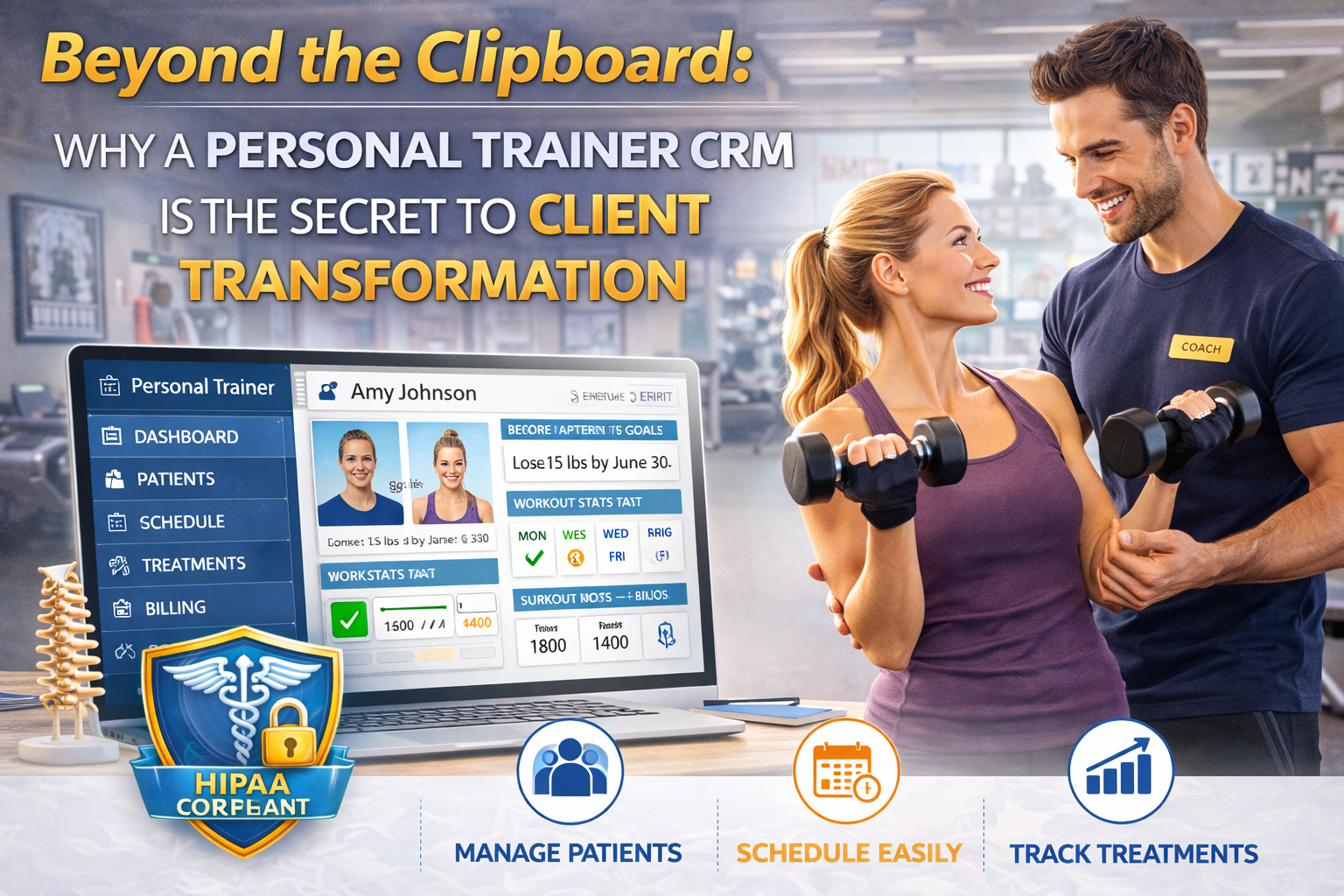
Stop losing track of client gains. Discover how a Personal Trainer CRM automates progress tracking, improves retention, and professionalizes your fitness business.
Table of Contents
I’ll never forget the first time I walked into a high-end boutique gym located in a converted industrial loft. The real estate was breathtaking—exposed brick, soaring ceilings, and natural light that made every piece of chrome equipment shine. But when I met the head trainer, he was carrying a weathered spiral notebook that looked like it had been dropped in a protein shake. He spent ten minutes flipping through pages just to find a client’s previous deadlift max.
“I’m a great coach,” he told me, “but I’m drowning in my own notes.”
This is a scenario I see constantly in both the fitness and the commercial real estate sectors. Professionals invest thousands into a premium lease and top-tier equipment, yet they neglect the digital infrastructure that actually manages the “product”—which, for a trainer, is client progress. If you are still relying on a paper log or a messy group of spreadsheets, you aren’t just wasting time; you are capping your income and risking your professional reputation.
Moving to a specialized Personal Trainer CRM is about more than just going digital. It’s about creating a “single source of truth” for every rep, set, and weigh-in. In a market where clients have endless options, the “experience” you provide outside of the gym floor is what determines if they stay for a month or a decade. A Personal Trainer CRM allows you to provide a high-touch, professional service that matches the premium price point of your studio.
Why Data-Driven Coaching Wins Every Time
In real estate, we rely on “comps” and market data to prove value. In fitness, you need data to prove results. A client might feel like they aren’t making progress after a month of hard work, and if you can’t show them a chart that proves their body fat percentage has dropped or their strength has increased by 15%, they are going to cancel their membership.
A Personal Trainer CRM allows you to log every workout in real-time. Instead of guessing, you can pull up a visual graph of their progress over the last six months. This visual evidence is a powerful psychological tool. It transforms “I think I’m getting stronger” into “I know I’m getting stronger.” When a client sees the data, they stay motivated, and motivated clients are the ones who sign those long-term renewal contracts.
Maximizing Your Gym’s Real Estate ROI
If you are a trainer renting space or owning a small studio, every square foot has to be profitable. You need to maximize “client throughput” without sacrificing the quality of the coaching. A Personal Trainer CRM helps you manage the “business of the gym” just as much as the workouts.
By automating your scheduling and progress tracking, you reduce the “admin gap” between sessions. You don’t need a fifteen-minute buffer to write down notes if you’ve already logged them in your Personal Trainer CRM on your tablet while the client was cooling down. This efficiency allows you to see one or two extra clients per day, which can be the difference between barely covering your commercial lease and having a highly profitable business.
According to data often discussed by the National Association of Realtors (NAR), fitness-based tenants are becoming “anchor” tenants for many retail developments because they drive consistent foot traffic. However, your stability as a tenant depends on your ability to retain those members. Using a Personal Trainer CRM is the best way to ensure your retention rates stay high enough to support your overhead.
Creating a Professional Paper Trail for Liability
Let’s talk about the “boring” stuff that keeps you up at night: liability. If a client gets injured, the first thing an insurance company or a lawyer will ask for is your training logs. If you hand them a stack of loose-leaf paper, you are in a weak position.
A dedicated Personal Trainer CRM provides a timestamped, unalterable record of every workout. It proves that you followed a progressive, safe program and that you weren’t pushing a client beyond their documented capabilities. This level of professionalism is vital if you are looking to secure a lease in a high-end medical office building or a luxury residential complex. Property managers want to see that you have your “risk management” in order.
For a deeper look at the administrative evolution of these tools, Wikipedia’s entry on Customer Relationship Management provides great context on how digital systems moved from basic sales trackers to full-scale operational managers. In your gym, the Personal Trainer CRM is the conductor of your entire office symphony.
The Personal Touch: Tracking More Than Just Reps
The “Customer” part of a Personal Trainer CRM is just as important as the “Workout” part. You need to remember their daughter’s graduation, their favorite post-workout smoothie, and the fact that they are traveling to a specific city for work next week.
A professional Personal Trainer CRM allows you to store these “soft” details alongside their bench press numbers.
- Automated Reminders: Send a “Happy Birthday” or “Good luck on your presentation” message.
- Travel Programs: Use the Personal Trainer CRM to push a bodyweight workout to their phone while they are at a hotel.
- Nutrition Logs: Link their daily caloric intake directly to their training volume.
As noted by the Lincoln Institute of Land Policy, the digital transformation of professional services is making data-driven management the standard for all successful business ventures. A trainer who ignores this data is effectively devaluing their own professional equity.
Improving Retention with “Gamification”
One of the coolest features of a modern Personal Trainer CRM is the ability to “gamify” the fitness journey. You can set up leaderboards, award digital badges for hitting milestones, and share progress reports directly to the client’s social media.
This creates a community around your brand. When people feel like they are part of a winning team, they don’t want to leave. From a real estate perspective, this creates a “destination” business. People will travel past three other gyms just to get to yours because they love the community and the feedback loop your Personal Trainer CRM provides. You aren’t just selling a workout; you’re selling a transformation.
Key Features Checklist for a Personal Trainer CRM:
- Mobile-Friendly Interface: You must be able to log reps on the fly without leaving the client’s side.
- Integrated Payments: Don’t make “billing” an awkward conversation; handle it automatically through the Personal Trainer CRM.
- Client App: Give your clients a “window” into their own progress and a place to book their own sessions.
- Assessment Tools: Log body composition, flexibility scores, and postural photos in one secure place.
- Resource Library: Store video tutorials for “homework” exercises within the Personal Trainer CRM.
FAQ Section
Will a Personal Trainer CRM be too complicated for my older clients? Most modern systems have a very “clean” client interface. If they can use a smartphone to check their email or a weather app, they can use a Personal Trainer CRM. You can also control how much data they see, keeping it as simple or as detailed as they prefer.
How much does a Personal Trainer CRM typically cost? Prices vary based on the number of clients you have, but most solo trainers find the system pays for itself through saved time and improved retention. Usually, it costs about the same as one or two personal training sessions per month.
Can I use it to manage my group fitness classes too? Yes! A high-quality Personal Trainer CRM will allow you to manage one-on-one sessions, semi-private groups, and large classes all in one calendar. This prevents double-booking and makes it easy to track attendance and billing for every format.
Is my client’s health data secure in the cloud? Security is a top priority for reputable Personal Trainer CRM providers. They use enterprise-level encryption and are often HIPAA-compliant (or similar standards), making your digital files much safer than a physical folder sitting on a gym counter.
Does a Personal Trainer CRM help with getting more clients? Absolutely. Many systems have built-in “Lead Management” tools. When someone inquires through your website, the Personal Trainer CRM captures their info and sends an automated follow-up, ensuring you never miss a potential new member.
Conclusion
At the end of the day, your personal training business is built on results. But those results have to be documented, analyzed, and shared to have a real impact on your bottom line. A Personal Trainer CRM is the bridge between the hard work on the gym floor and the financial success in your bank account.
By automating the “boring” administrative tasks, you free yourself up to be a better coach. You can focus on the form, the intensity, and the human connection—the things that actually drive results. Don’t let the paperwork hold you back from building the fitness empire you’ve dreamed of. Invest in the technology that allows you to see every client as a data-driven success story. When you trade the messy notebook for a streamlined Personal Trainer CRM, you aren’t just modernizing your gym; you’re securing your future in a competitive industry.
