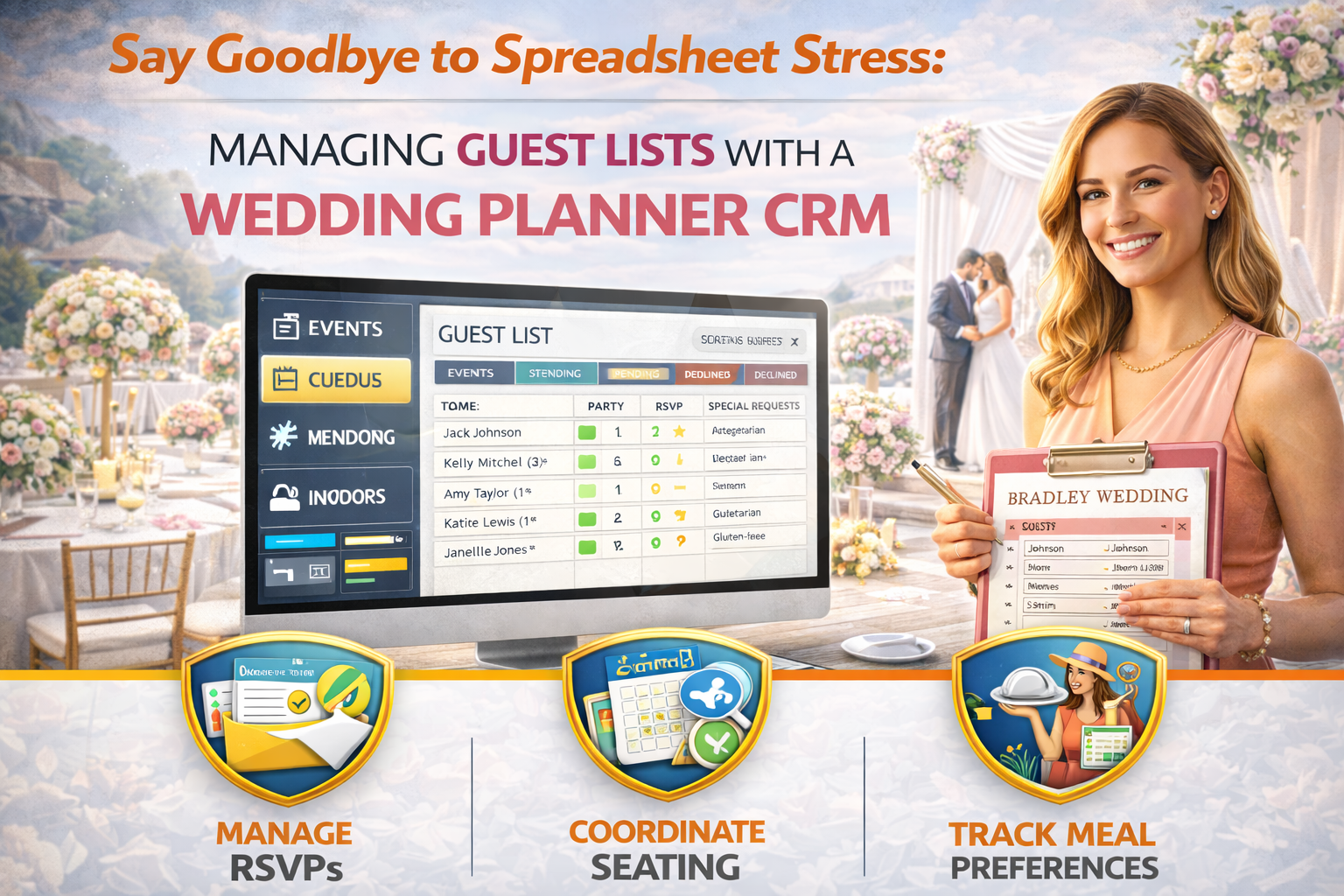
Tired of manual RSVP tracking? Discover how a Wedding Planner CRM automates guest lists, manages meal choices, and streamlines your event coordination.
Table of Contents
I’ll never forget a wedding I helped coordinate at a stunning beachfront estate a few years back. The setting was perfect, the sunset was a dream, but behind the scenes, the planner was having a minor meltdown. She was clutching a three-ring binder with a coffee-stained guest list, frantically trying to figure out if “Aunt Linda” had requested the sea bass or the filet mignon.
In the high-stakes world of event planning and luxury residential real estate venues, these tiny details are what separate a legendary evening from a logistical disaster. If you are still relying on a messy spreadsheet or a collection of sticky notes to manage a hundred different personalities, you aren’t just working hard—you are inviting a catastrophe.
This is exactly where a specialized Wedding Planner CRM changes the game. It isn’t just a digital address book; it’s the central nervous system of your entire planning process. By moving your guest lists and RSVPs into a Wedding Planner CRM, you trade the chaos of “I think they responded” for the absolute certainty of real-time data. It allows you to focus on the “Experience and Expertise” that your clients are paying for, rather than playing detective with a stack of mail-in response cards.
The Nightmare of Manual RSVP Tracking
Let’s be honest: tracking guests is the least “glamorous” part of wedding planning. You’re dealing with last-minute plus-ones, dietary restrictions that seem to change by the hour, and that one cousin who ignores every deadline. When you manage this manually, the margin for error is massive.
A Wedding Planner CRM eliminates this friction by providing a digital portal for the couple and their guests. Instead of waiting for the mail to arrive, the moment a guest clicks “Accept” on their digital invite, the CRM updates the master list. It’s instantaneous. This efficiency is vital when you are working with high-end real estate venues that require final headcounts weeks in advance for security and catering logistics.
Organizing Meal Choices and Dietary Restrictions
In modern hospitality, “one size fits all” is a relic of the past. You have vegans, keto enthusiasts, and serious nut allergies to worry about. If you lose track of these, you aren’t just looking at a cold plate; you’re looking at a potential medical emergency.
Inside a Wedding Planner CRM, these details are linked directly to the guest’s profile. When you generate a report for the caterer, you aren’t just handing them a number; you are handing them a precise map of every seat in the house. This level of organization is what builds “Trust” with venue owners and property managers who need to ensure their staff is prepared for any scenario.
According to data often discussed by the National Association of Realtors (NAR), properties used as event venues require a much higher level of management and documentation. Using a Wedding Planner CRM provides that professional paper trail, ensuring that the usage of the property remains compliant with local safety and fire codes.
Integrating Seating Charts with Real-Time Data
There is no puzzle quite as complex as a wedding seating chart. You have to keep the feuding siblings apart while ensuring the “power players” are close to the action. If you try to do this on a poster board with post-it notes, one gust of wind can ruin a week’s worth of work.
A top-tier Wedding Planner CRM allows you to build a visual seating map that is synced with your RSVP list. As people confirm their attendance, you can drag and drop them into their designated spots. If someone cancels at the last minute—and they always do—you can adjust the layout in seconds. This flexibility is a godsend when you are working with a tight floor plan in a historic mansion or a boutique hotel.
For a deeper look at the administrative evolution of these systems, Wikipedia’s entry on Customer Relationship Management offers great context on how these tools moved from basic sales databases to complex event-driven platforms. A Wedding Planner CRM is essentially a project management tool tailored for the “heart” of the event.
Improving the Relationship with Venue Owners
If you frequently book luxury rentals or private estates for your clients, the property owners want to know their home is in good hands. They want to see a professional list of who is entering the property for liability and insurance purposes.
By using a Wedding Planner CRM, you can provide a clean, professional guest manifest with the click of a button. This level of transparency makes you the “preferred planner” for these exclusive locations. When a venue owner knows you have a digital handle on the guest list, they are much more likely to trust you with their multi-million dollar asset. As noted by the Lincoln Institute of Land Policy, the digital transformation of property usage is making data more accessible and necessary for every stakeholder involved.
Automated Reminders: The End of Chasing Guests
We’ve all been there: the deadline for the caterer is tomorrow, and thirty people still haven’t responded. Traditionally, this meant the planner or the couple had to spend an entire afternoon making awkward phone calls.
A Wedding Planner CRM handles the “nudging” for you. You can set up automated email or text reminders for anyone who hasn’t RSVP’d by a certain date. It’s polite, it’s persistent, and it’s remarkably effective. It keeps the project moving forward without you having to be the “bad guy.” This automation allows you to scale your business, managing multiple high-end weddings at once without the wheels falling off your schedule.
Key Features Checklist for a Wedding Planner CRM:
- Guest Self-Service: Let guests update their own addresses and meal choices.
- Mobile Accessibility: Access your guest list on your phone while you’re on a site visit at a potential venue.
- Plus-One Management: Strictly control who is allowed to bring a guest to keep the budget in check.
- Gift Tracking: Log who gave what in real-time to make the “Thank You” note process effortless for the couple.
- Vendor Integration: Share specific guest data (like allergies) directly with the kitchen staff.
The Financial Impact: Avoiding “Ghost” Plates
Let’s talk about the bottom line. At a high-end wedding, a single “plate” can cost upwards of $200. If your guest list is disorganized and you over-order by just ten people, that’s $2,000 of your client’s budget literally thrown in the trash.
A Wedding Planner CRM ensures that your final count is accurate down to the last person. It prevents the “ghost plate” problem where you pay for people who aren’t there or, worse, don’t have enough food for people who showed up unannounced. In the competitive world of event planning, being a good steward of your client’s budget is the fastest way to get glowing referrals and five-star reviews.
FAQ Section
Is a Wedding Planner CRM worth the cost for a small boutique firm? Absolutely. In fact, for a solo planner, it’s even more vital. When you are the only one handling the logistics, you need the software to act as your virtual assistant. The time you save on manual RSVP tracking alone will pay for the Wedding Planner CRM subscription for the entire year.
Can I manage my vendor contracts in the same system? Yes, most professional Wedding Planner CRM options allow you to store contracts, invoices, and contact info for all your florists, DJs, and photographers in the same place as your guest list. This creates a “single source of truth” for the entire wedding.
Does a Wedding Planner CRM help with “Day-Of” coordination? It’s a lifesaver. You can use the CRM to check guests in as they arrive, ensuring that you know exactly who is in the building. If a “surprise” guest shows up, you can quickly check the digital list to see if they were actually invited or if they’re a plus-one that wasn’t registered.
How secure is the guest data in the cloud? Professional Wedding Planner CRM providers use enterprise-level encryption and regular backups. Your clients’ sensitive data (like home addresses and phone numbers) is significantly safer in a secure digital environment than it is in a physical binder that could be left in a taxi.
Can I use the same Wedding Planner CRM for corporate events? While many of the features overlap, a Wedding Planner CRM is specifically designed for the emotional and logistical nuances of a wedding. However, many planners find that they can easily adapt the guest management tools for high-end corporate retreats or residential real estate launch parties.
Conclusion
At the end of the day, a wedding is a theatrical performance where you are the director. You are managing a cast of hundreds in a high-pressure environment. A Wedding Planner CRM is the script that keeps everyone on cue.
Don’t let the administrative “noise” of guest lists and RSVPs distract you from the magic of the day. Invest in the technology that allows you to automate the “boring stuff” so you can focus on the “human stuff.” When you organize your guest data through a Wedding Planner CRM, you aren’t just managing an event—you are ensuring a flawless experience for the couple and protecting the professional reputation you’ve worked so hard to build.
