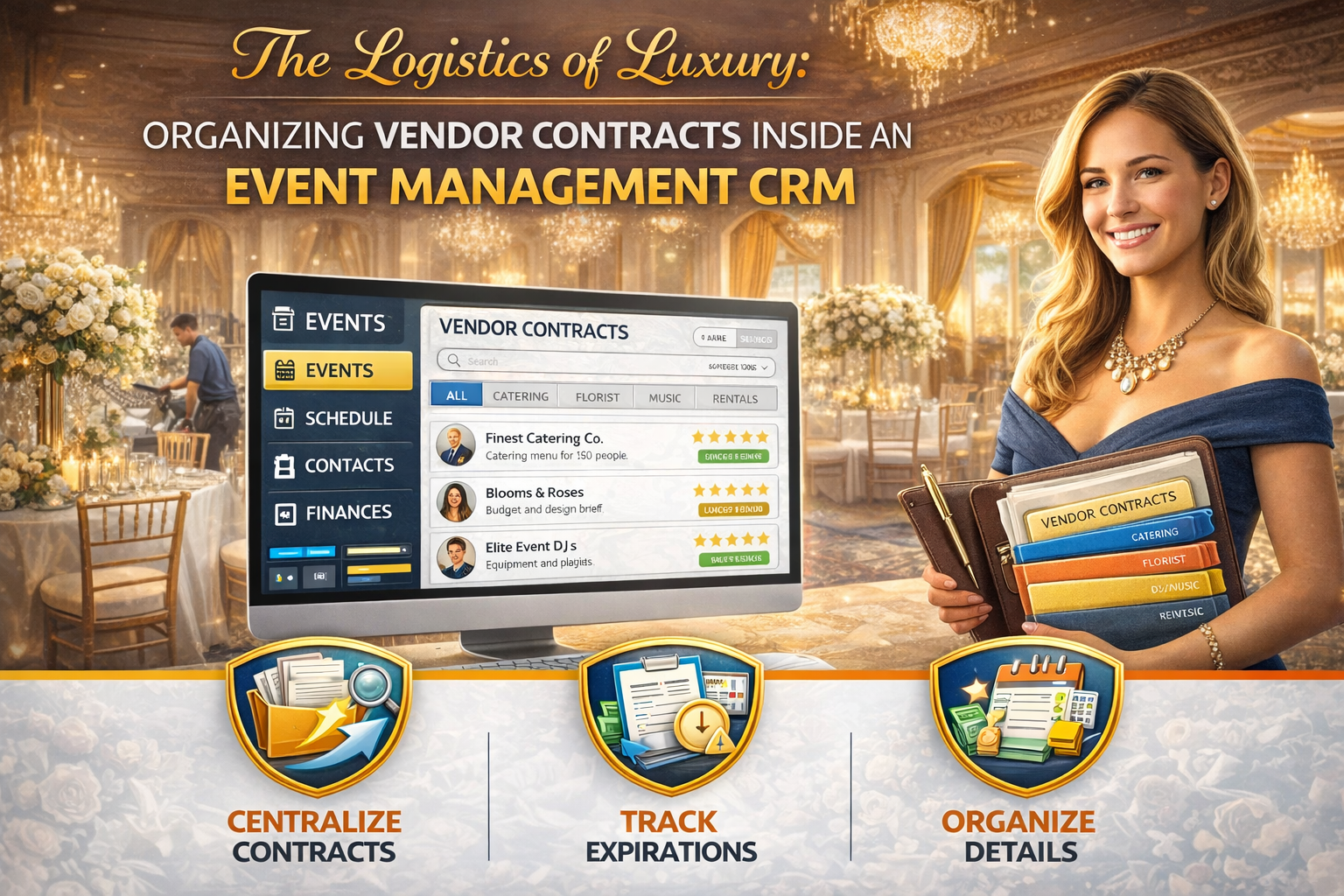
Stop losing track of paperwork. Learn how an Event Management CRM streamlines vendor contracts, secures your data, and ensures your real estate events run flawlessly.
Table of Contents
I’ll never forget a grand opening event I attended for a luxury penthouse development in the city. The catering was exquisite, the lighting was perfect, and the guest list was a “who’s who” of local real estate investors. But behind the scenes, the event coordinator was a nervous wreck. Ten minutes before the ribbon-cutting, the valet service claimed they hadn’t been paid the deposit, and the florist was arguing about a delivery window that wasn’t in their “final” email.
The coordinator was frantically digging through a bloated accordion folder of loose papers, trying to find the signed agreements. It was a classic “paper-trail nightmare” that nearly derailed a multi-million dollar marketing opportunity.
Whether you are hosting a high-stakes auction, a broker’s open house, or a tenant appreciation gala, your success depends on your vendors. But managing those relationships—and more importantly, their contracts—can feel like herding cats. This is exactly where a specialized Event Management CRM becomes your most valuable asset. It isn’t just about sending invitations; it’s about creating a centralized, digital vault where every contract, certificate of insurance, and payment milestone is tracked and secured. When you move your logistics into an Event Management CRM, you trade the chaos of “I think we signed that” for the confidence of “I know we did.”
The Centralized Vault: Why One Source of Truth Matters
In the fast-moving world of real estate events, you are often juggling a dozen vendors at once. You have caterers, AV technicians, staging companies, and security personnel. Traditionally, these contracts lived in separate email threads, PDF attachments, or—heaven forbid—physical filing cabinets.
An Event Management CRM eliminates this fragmentation. By uploading every agreement into a central profile, you ensure that anyone on your team can see the latest version of the contract in seconds. You don’t want to be the person searching for a “revised_final_v2.pdf” on your phone while the caterer is waiting for an answer.
In luxury residential real estate, where brand image is everything, having a “single source of truth” inside your Event Management CRM protects your reputation. It allows you to hold vendors accountable to the specific terms you negotiated, from the exact number of hors d’oeuvres to the specific teardown time.
Tracking Insurance and Liability in a Digital Space
Let’s talk about the “boring” stuff that keeps you up at night: liability. If a guest trips over a rogue speaker wire at your open house, you need to know immediately that your AV vendor’s insurance is active and that they’ve signed your indemnity waiver.
A high-performance Event Management CRM allows you to set “expiration alerts” for vendor documents. If a florist’s general liability insurance expires two days before your event, the system can automatically flag it. This level of proactive management is vital for real estate professionals who are often hosting events on behalf of property owners or developers.
According to data often discussed by the National Association of Realtors (NAR), managing risk is a primary concern for modern brokerages. By using an Event Management CRM to verify that every vendor is fully compliant before they even step onto the property, you are adding an essential layer of protection to your business.
Automated Deadlines: Deposits, Deliveries, and Deadlines
One of the biggest “leaks” in event budgets comes from missed payment deadlines or late-delivery fees. Most vendor contracts have a strict schedule—30% down to hold the date, 50% thirty days out, and the balance upon completion.
Inside your Event Management CRM, these isn’t just text on a page; they are actionable alerts. You can set the system to remind you (and the vendor) when a payment is due. This ensures your cash flow stays organized and your vendors stay happy. Happy vendors go the extra mile, which is exactly what you need when you’re trying to impress a room full of prospective buyers.
Furthermore, an Event Management CRM can track the “small print” logistics. If the staging company’s contract states they need a four-hour window for installation, that data can be pushed directly to your master event timeline. This “logistical synergy” is what separates a good event from a legendary one.
Improving Vendor Relationships Through Professionalism
Vendors love working with organized clients. When you use an Event Management CRM, you provide your vendors with a “Client Portal” where they can see their own tasks, upload their invoices, and confirm their arrival times.
This professional interface signals that you are a serious player in the market. In the competitive real estate sector, being a “preferred client” for the best vendors in town is a massive advantage. For a deeper look at the administrative evolution of these systems, Wikipedia’s entry on Customer Relationship Management offers great context on how digital tools moved from sales-only to full-scale operational support.
Real-Life Example: The Multi-Phase Development Launch
I recently worked with a developer who was launching a three-phase condo project. They had events planned over an eighteen-month period. Without an Event Management CRM, they would have been reinventing the wheel for every single launch.
Instead, they used their Event Management CRM to “clone” successful vendor contracts and timelines. They kept a history of which caterers were the most reliable and which AV companies consistently under-performed. This historical data allowed them to refine their vendor pool for each subsequent phase, ultimately lowering their costs and increasing the “vibe” of their sales events.
As noted by the Lincoln Institute of Land Policy, the digital transformation of land and property management is accelerating. Adapting an Event Management CRM for your internal logistics is part of that same push toward a more data-driven, efficient industry.
Security and Permission: Protecting Sensitive Data
Vendor contracts often contain sensitive information—bank routing numbers for wires, private cell phone numbers, and specific pricing that might be confidential. You can’t just have these sitting on a shared Google Drive with “open” permissions.
A specialized Event Management CRM allows for granular permissions. You can ensure that your interns can see the delivery times, but only the project manager can see the financial totals and the bank details. This security is non-negotiable in the real estate world, where “off-market” details and private client data must be guarded at all costs.
FAQ Section
Do I need an Event Management CRM if I only host two events a year? Even for a low volume of events, the organization a CRM provides is worth it. It creates a “playbook” for your business. If you hire a new assistant next year, they can look at the Event Management CRM and see exactly how you handled the previous year’s broker’s open, including which vendors you used and what the contracts looked like.
Can I integrate my existing email with the CRM? Yes! Most top-tier Event Management CRM platforms sync with Outlook or Gmail. This means that if a vendor sends you a contract via email, you can “tag” it and send it directly into the CRM without having to download and re-upload files manually.
Does an Event Management CRM help with budgeting? Absolutely. By pulling the financial data from your contracts, the Event Management CRM can provide real-time reporting on your “Estimated vs. Actual” spend. This is a game-changer for staying on budget and reporting back to your investors or partners.
Is it difficult to move my current paper contracts into a CRM? It takes a little bit of “upfront” work, but most systems allow you to drag and drop PDFs and use “optical character recognition” (OCR) to pull out key dates and totals. Once you’ve digitized your vendor list in the Event Management CRM, you’ll wonder how you ever survived without it.
Can vendors sign contracts directly inside the CRM? Yes. Most modern Event Management CRM options integrate with e-signature tools. This allows you to send an agreement to a vendor, have them sign it on their phone, and automatically save the completed document to their profile—no printing or scanning required.
Conclusion
At the end of the day, an event is a performance, and your vendor contracts are the script. If the script is lost or disorganized, the performance will suffer. An Event Management CRM is the stage manager that keeps everything running on cue.
Don’t let the administrative “noise” of vendor management distract you from your primary goal: closing deals and building relationships. Invest in the technology that allows you to automate the “boring stuff” so you can focus on the “human stuff.” When you organize your vendor contracts inside an Event Management CRM, you aren’t just filing papers; you are building a foundation for flawless, professional events that leave a lasting impression on your clients.
