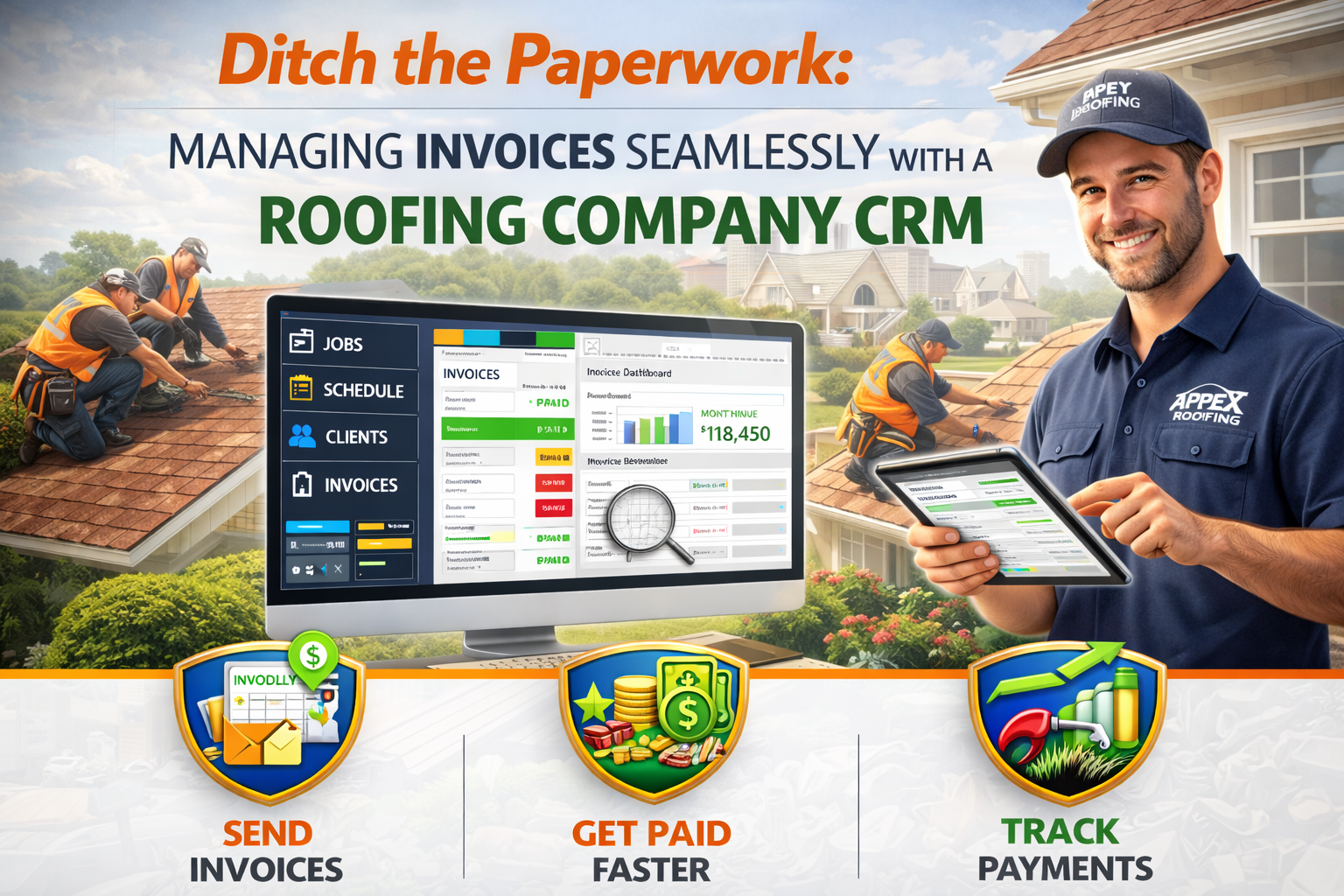
Tired of chasing payments and lost receipts? Discover how a Roofing Company CRM automates your invoicing and keeps your cash flow healthy and professional.
Table of Contents
I’ll never forget a conversation I had with a local contractor named Mike a few years back. Mike was one of the best roofers in the tri-state area; if you had a leak, he was the guy you called. But despite his skill on a shingle, his office looked like a hurricane had hit a stationery store. There were crumpled carbon-copy receipts on the dashboard of his truck, “pending” invoices tucked into the sun visor, and a pile of checks on his kitchen table that he hadn’t found the time to deposit.
“I’m great at fixing roofs,” he told me, “but I’m terrible at getting paid for it.”
Mike’s struggle is the silent killer of many small-to-mid-sized trade businesses. You do the hard work, you manage the crew, and you provide a great service, but the administrative “static” of billing and collections starts to drain your energy. In the fast-moving real estate and construction market, relying on manual billing is a recipe for disaster. This is exactly where a specialized Roofing Company CRM becomes your most valuable tool on the job site.
By moving your financial operations into a dedicated Roofing Company CRM, you aren’t just getting organized; you’re professionalizing your brand. You’re making it easy for homeowners, property managers, and real estate investors to pay you. When the “money part” of the business becomes seamless, you stop chasing checks and start growing your empire.
The Bottleneck of Traditional Invoicing
In the world of residential real estate, a roofing project is a major event. Whether it’s a pre-sale upgrade or an emergency repair after a hailstorm, the paperwork involved is significant. If you’re still hand-writing invoices, you are prone to human error—miscalculating the tax, forgetting the cost of that extra venting, or simply losing the customer’s email address.
A Roofing Company CRM eliminates this friction by creating a digital bridge between the estimate and the final bill. The system knows exactly what materials were used and how many labor hours were logged. Instead of spending your Sunday night trying to remember if you charged for that extra pallet of shingles, you can generate a professional, branded invoice with two clicks.
Speeding Up the “Cash-to-Cash” Cycle
The health of your business is determined by your cash flow. If you finish a roof on a Tuesday but don’t get around to mailing the invoice until the following Monday, you’ve just given your client a six-day interest-free loan. When you use a Roofing Company CRM, the invoice can be sent before the crew even leaves the driveway.
Modern systems allow for “on-site” approvals. Your project manager can walk the homeowner through the finished work, get a digital signature on a tablet, and trigger an automated email with the invoice and a “Pay Now” button. This immediacy is a game-changer. I’ve seen companies reduce their “Days Sales Outstanding” (DSO) by half simply by implementing a Roofing Company CRM.
Professionalism That Wins Real Estate Contracts
If you work with real estate agents or professional property managers, they demand a higher level of documentation. They need clear line items, professional formatting, and instant receipts for their accounting records. A handwritten scrawl on a generic notepad just doesn’t cut it when you’re dealing with a $20,000 commercial roof or a multi-unit rental property.
Using a Roofing Company CRM tells your high-value clients that you are a modern, reliable business. It builds the “Experience, Expertise, and Trust” that leads to recurring referrals. When a Realtor knows that your invoicing is as solid as your craftsmanship, you become their first call for every pre-listing inspection and repair.
According to data often discussed by the National Association of Realtors (NAR), the condition of the roof is one of the top three factors in a successful home sale. By providing a clean, digital paper trail through your Roofing Company CRM, you are helping your clients protect their investment and navigate the closing process with confidence.
Managing Complex Insurance Claims
Let’s be honest: a huge portion of the roofing business involves dealing with insurance adjusters. This is where most contractors lose their minds. You have to track the initial estimate, the “actual cash value” (ACV) payment, the deductible, and the final “replacement cost value” (RCV) depreciation.
A specialized Roofing Company CRM is built to handle this multi-step financial dance. It keeps all the insurance documents, photos of the damage, and payment milestones in one secure place. You can see at a glance who still owes you for the supplemental claim and who has already paid their deductible. For a deeper look at the legal and financial structures of these contracts, Wikipedia’s entry on Construction Management offers a great foundation on how professional firms handle project accounting.
Integrating Invoices with Your Accounting Software
One of the biggest mistakes I see is a contractor using one system for their customer list and another for their books, with no communication between the two. This leads to “double-entry” errors and hours of wasted time.
A top-tier Roofing Company CRM will sync directly with platforms like QuickBooks or Sage. When an invoice is paid in the CRM, it’s automatically recorded in your accounting software. This ensures that your books are always up to date and makes tax season a breeze rather than a nightmare. When your Roofing Company CRM talks to your bank account, you gain a level of financial clarity that allows you to make better decisions about hiring and equipment purchases.
Tracking Material Costs and Profit Margins
In an era of fluctuating material prices, you need to know your margins on every single job. If the price of plywood goes up 10% between the estimate and the start date, you need to know how that impacts your bottom line.
A Roofing Company CRM allows you to track your material orders and tie them directly to the specific job invoice. You can run “Job Costing” reports to see which types of roofs are your most profitable and which ones are barely breaking even. This data-driven approach is what allows a small crew to grow into a regional powerhouse.
As noted by the Lincoln Institute of Land Policy, the digital transformation of property-related services is accelerating. Embracing a Roofing Company CRM is about more than just convenience; it’s about remaining competitive in an industry that is rapidly leaving the “pencil and paper” era behind.
Essential Invoicing Features to Look For:
- Automated Reminders: Let the Roofing Company CRM send the “friendly reminder” emails for overdue payments so you don’t have to be the “bad guy.”
- Mobile Payment Integration: Accept credit cards or ACH payments on-site to get your funds faster.
- Progress Billing: For large projects, easily invoice for the deposit, the material delivery, and the final completion.
- Photo Attachments: Include photos of the completed work on the invoice to eliminate “I didn’t see the work” excuses.
- Warranty Tracking: Link the final invoice to the roof’s warranty documentation for the homeowner’s peace of mind.
FAQ Section
Will a Roofing Company CRM be too complicated for my crew? Most modern systems are designed with a “field-first” mentality. If your crew can use a smartphone to check the weather or scroll through social media, they can use a Roofing Company CRM. The key is to choose a system with an intuitive mobile app.
How much does it typically cost? While prices vary based on your team size, most Roofing Company CRM platforms pay for themselves within a few months. The amount of “unbilled” labor and “forgotten” materials you’ll recover usually far outweighs the monthly subscription fee.
Can I use it to manage my subcontractors? Yes. A high-quality Roofing Company CRM allows you to track subcontractor invoices and payments just as easily as you track your own. This ensures everyone is on the same page and reduces disputes over pay.
Is my data safe in a CRM? Professional Roofing Company CRM providers use enterprise-level encryption and regular cloud backups. Your financial records are much safer in a secure digital environment than they are in a physical file cabinet or on a single office laptop.
Does it help with marketing? Indirectly, yes! By providing a seamless, professional invoicing experience through your Roofing Company CRM, you increase the likelihood of positive reviews and referrals. You can also use the data to send out “check-up” reminders to past clients five or ten years down the road.
Conclusion
At the end of the day, your roofing company is a service business, and the quality of that service is tied directly to your organization. You can be the best roofer in the world, but if your billing is a mess, your business will struggle.
A Roofing Company CRM is the key to unlocking a higher level of efficiency and profit. It allows you to spend more time on the ladder and less time at the desk. By automating your invoices and streamlining your cash flow, you are building a foundation that is as strong as the roofs you install. If you want to scale your business and protect your hard-earned equity, it’s time to stop the manual struggle and embrace the digital future.
