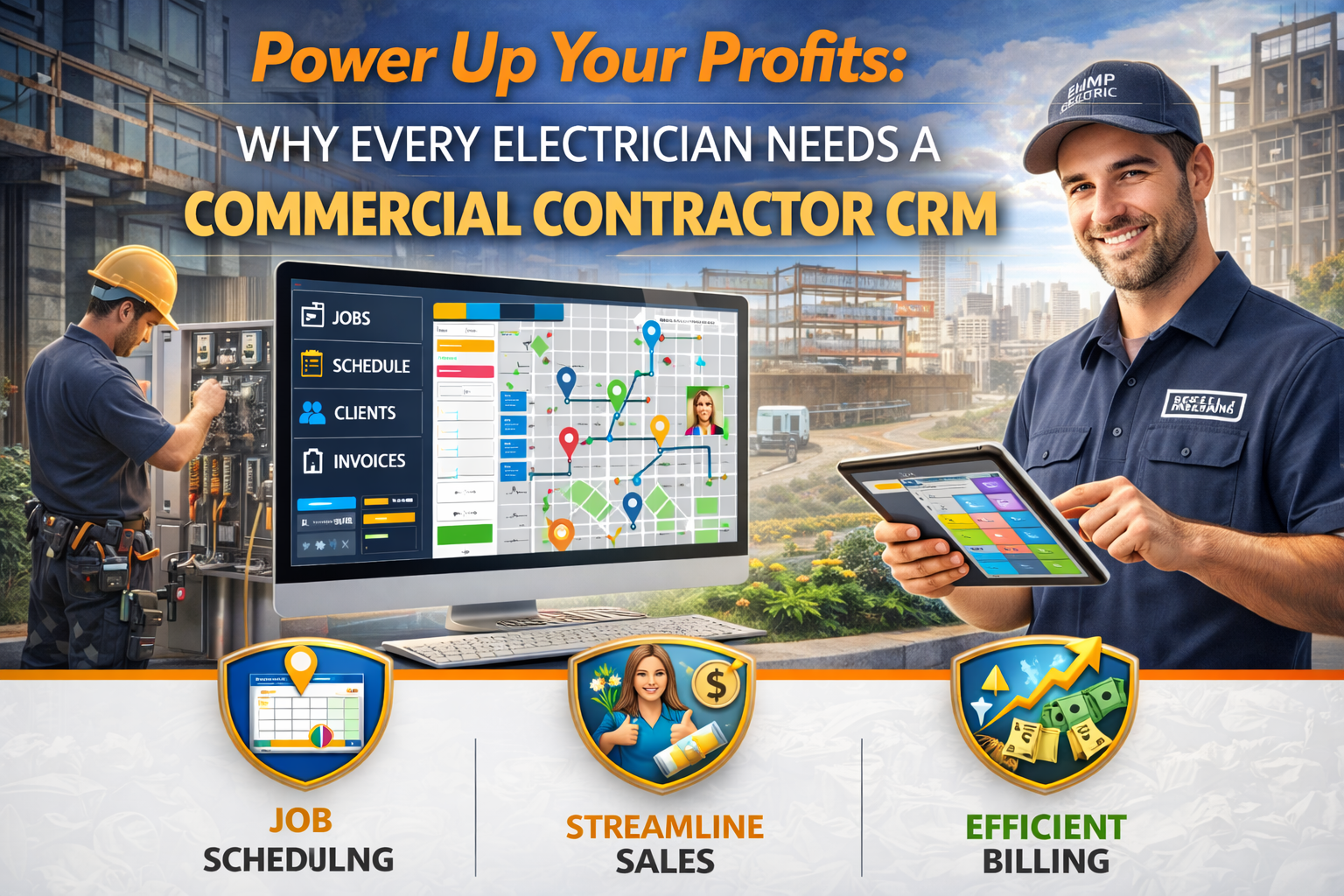
Tired of juggling complex bids and messy schedules? Discover how a Commercial Contractor CRM helps electricians manage large-scale projects and boost ROI.
Table of Contents
I’ll never forget a conversation I had with an old friend, Mike, who runs a mid-sized electrical firm. He had just landed a massive contract for a new mixed-use development—the kind of project with hundreds of residential units and a ground-floor retail space. On paper, it was the win of a lifetime. But three months in, Mike looked like he’d aged a decade. He was drowning in change orders, losing track of sub-consultants, and realized half his team was idling because of a scheduling overlap he hadn’t seen coming.
“I’m a great electrician,” he told me over a very necessary coffee. “But I’m a terrible filing cabinet.”
Mike’s struggle is common in the trade world. Moving from small residential service calls to large-scale infrastructure projects is like moving from a bicycle to a freight train. The logistics are heavier, the stakes are higher, and the room for error is razor-thin. This is exactly where a specialized Commercial Contractor CRM becomes more than just software—it becomes the digital backbone of your entire operation.
When you are managing multi-phase builds, you can’t rely on luck or a weathered leather notebook. You need a centralized system that understands the heartbeat of a construction site. By implementing a Commercial Contractor CRM, you aren’t just “getting organized.” You are building a scalable engine that ensures your bids are accurate, your crews are efficient, and your profit margins are protected from the “silent killers” of the industry: miscommunication and administrative lag.
The Complexity of the Commercial Landscape
In the residential real estate market, an electrician might deal with a homeowner and maybe a general contractor. It’s a straightforward relationship. In the commercial world, however, you are navigating a web of stakeholders—property developers, architects, local inspectors, and site managers.
A Commercial Contractor CRM acts as the single source of truth for all these interactions. If a developer asks why the wiring for the third floor was delayed, you don’t want to spend forty minutes digging through emails. You want to pull up your Commercial Contractor CRM and show them the exact timestamp when the materials were held up at the warehouse. This level of transparency builds the “Experience, Expertise, and Trust” that keeps high-value clients coming back to you for their next project.
Streamlining the Bid Process and Estimating
In commercial real estate, the bidding war is won or lost in the details. If you under-estimate the labor hours for a warehouse retrofit, you’re basically paying to work. A Commercial Contractor CRM allows you to store historical data from previous jobs, making your future estimates much more accurate.
- Template-Based Bidding: Stop reinventing the wheel for every proposal. Use your CRM to build templates that reflect current material costs.
- Lead Tracking: Not every inquiry is a winner. Use your Commercial Contractor CRM to identify which developers provide the best ROI and focus your energy there.
- Automated Follow-ups: In the busy world of commercial construction, sometimes the person who follows up the fastest gets the job.
According to data often cited by the National Association of Realtors (NAR), commercial property demand remains resilient in urban hubs, but the competition among subcontractors is fiercer than ever. Having a professional Commercial Contractor CRM gives you a “corporate” edge that makes smaller shops look, well, small.
Managing Change Orders Without the Headache
If there is one thing that kills an electrician’s profit, it’s the unrecorded change order. You’re on-site, the architect asks for an extra outlet in the lobby, and your tech does it. But if that doesn’t get documented and billed, that’s money out of your pocket.
A specialized Commercial Contractor CRM allows your field technicians to log change orders on their tablets instantly. They can get a digital signature from the site supervisor before the wire is even cut. This ensures that every bit of extra labor and material is accounted for when the final invoice is generated. For a deeper look at how these systems evolved from basic databases to complex project management tools, Wikipedia’s entry on Customer Relationship Management provides a great historical foundation.
Scheduling, Dispatching, and Labor Costs
Labor is your biggest expense and your most volatile variable. If your crew is sitting in a van waiting for a site to be cleared, you are losing money. A Commercial Contractor CRM gives you a bird’s-eye view of your entire workforce.
You can see who is on-site, who is finishing up, and who is available for an emergency service call at a local retail center. This real-time dispatching is vital for maintaining a healthy relationship with property management firms who need fast results to keep their tenants happy. By optimizing your routes and schedules through your Commercial Contractor CRM, you reduce fuel costs and maximize the billable hours of your most skilled workers.
As noted by the Lincoln Institute of Land Policy, the digital transformation of the built environment is accelerating. Electricians who embrace a Commercial Contractor CRM are better positioned to work on “smart buildings” and complex infrastructure projects that require high-level data integration.
Protecting Your Legal Interests and Compliance
In large-scale real estate developments, the paperwork isn’t just about getting paid; it’s about protection. You need to track safety certifications, insurance documents, and building permits.
A Commercial Contractor CRM stores these documents in a secure, cloud-based vault. If an inspector asks for the wiring schematics or proof of a safety briefing from three months ago, you have it at your fingertips. This level of organization is a massive asset during the “due diligence” phase of a commercial sale, where buyers want to see a clean history of all mechanical and electrical work performed on the building.
Real-Life Example: The Retail Retrofit
I recently worked with an electrical contractor who was hired to retrofit an old department store into a modern tech hub. The project involved five different “sub-phases.” Without a Commercial Contractor CRM, the team would have been buried in spreadsheets. Instead, they used the CRM to track the material shipments for each phase separately. When a specific type of LED fixture was backordered, the CRM alerted the project manager, who shifted the crew to the HVAC wiring phase. They saved three days of downtime—savings that went directly to the bottom line.
Integrating with Financial Tools
You don’t want your office staff manually entering data from a work order into your accounting software. That is a recipe for typos and lost revenue. A top-tier Commercial Contractor CRM will sync seamlessly with platforms like QuickBooks or Sage.
This ensures that as soon as a job is marked “complete” in the field, the invoice is ready for review in the office. This “frictionless” billing cycle is what keeps your cash flow healthy. In the world of commercial contracting, where “Net 30” or “Net 60” payment terms are the norm, you can’t afford any delays in getting your invoices out the door. Your Commercial Contractor CRM is the bridge that connects the physical work to your bank account.
FAQ Section
Is a Commercial Contractor CRM too expensive for a small team? Actually, it might be more expensive not to have one. While there is a monthly subscription fee, the amount of money you save by eliminating lost change orders and reducing administrative hours usually pays for the software within the first few months.
Can I use a residential CRM for commercial work? You could try, but you’ll likely find it lacking. Commercial work requires tracking multiple stakeholders, complex project phases, and specific compliance documents that most residential-focused systems simply aren’t built to handle. A dedicated Commercial Contractor CRM is tailored for the “heavy lifting” of the industry.
How long does it take to train my crew on the new system? Most modern systems are designed to be as intuitive as a smartphone app. If your techs can use social media, they can learn to use a Commercial Contractor CRM. The key is to show them how it makes their lives easier—no more messy paperwork or “forgotten” instructions from the office.
Does a Commercial Contractor CRM help with project management? Yes. While it is primarily a “relationship” tool, most commercial-grade CRMs include project management features like Gantt charts, task assignments, and milestone tracking. This allows you to manage the “people” and the “work” in the same place.
Will my data be secure in the cloud? Professional Commercial Contractor CRM providers use enterprise-level encryption and regular backups. Your data is significantly safer in a secure cloud environment than it is in a physical file cabinet or on a single office computer that could crash.
Conclusion
At the end of the day, your reputation as an electrician is built on the quality of your work, but your success as a business owner is built on the quality of your systems. A Commercial Contractor CRM is the ultimate tool for the modern professional who wants to step up into the world of large-scale real estate development.
Don’t let the administrative “static” interfere with your growth. Invest in the technology that allows you to bid with confidence, manage with clarity, and protect your hard-earned profits. When you trade the messy notebooks for a streamlined Commercial Contractor CRM, you aren’t just changing your software—you’re changing the trajectory of your business.
